Jump to section
I watched a Vastu-conscious buyer reject a near-perfect home last month — because their compass app gave them a wrong reading at the front door.
The home actually faced a direction this family had been searching for. But the phone, held at the threshold near appliances and wiring, swung twenty degrees off. They walked out in thirty seconds. They never came back.
That is not unusual. Most buyers checking Vastu at Bay Area home tours are doing it wrong — and so are most of their agents. Good homes get ruled out for the wrong reasons. Wrong homes get accepted because the real issue went unmeasured. If you are Vastu-conscious and buying a home in the Bay Area in 2026, this article is the most comprehensive resource I can give you.
I am Sanna Syngal, a Realtor with RE/MAX Accord serving Alameda, Santa Clara, San Mateo, and San Francisco counties. Before real estate, I spent years as a tech lead and a PMP-certified project manager. I work with a lot of Vastu-conscious buyers — across the entire price spectrum, from first-time buyers in starter condos to luxury buyers in $4M-plus single-family homes. Over the years, I have learned what my clients actually prioritize, where the real conflicts come up between Vastu and Bay Area housing stock, and one of the biggest problems in this market that almost nobody is talking about — most buyers and most agents do not know how to check the direction of a home correctly.
This is the article I wish I could send every new client who is buying a Bay Area home with Vastu in mind.
What This Article Is — and What It Isn't
I am not a Vastu consultant. I have not trained in Vastu Shastra. I am not the right person to tell you which direction your front door should face, or whether a particular layout is right for your family.
What I am is a Bay Area Realtor who has walked through hundreds of homes with Vastu-conscious buyers. I have sat at kitchen tables while families weighed a southwest entrance against a top-rated school district. I have watched buyers fall in love with a home and then walk away because the kitchen was in the wrong corner. I have coordinated with Vastu consultants during contingency periods.
What you are going to read here is observational, not prescriptive. It is what I have learned watching this market work. The elements my clients most often filter for. The patterns of Bay Area housing stock that make Vastu searches difficult. The mistake I see buyers make when they rely on online Vastu advice. The right way to actually measure the direction of a home. And the data-driven 16-zone analysis I run for clients who specifically ask me to take a closer look.
If you take one thing from this entire article, let it be this — if Vastu matters to your family, work with a qualified Vastu professional. Not a YouTube video. Not a Reddit thread. Not a Realtor (including me). Someone trained.
Everything else here is context.
What Vastu Shastra Is — and Its Cousin, Feng Shui
Vastu Shastra is an ancient Indian system of architecture and design that has been part of Indian culture for thousands of years. The word roughly translates to "the science of dwelling." Its core idea is that the way a home is oriented, laid out, and used can affect the energy and harmony of the family living in it.
The framework rests on a few foundational concepts:
- The five elements — earth, water, fire, air, and space
- The eight cardinal directions — north, northeast, east, southeast, south, southwest, west, and northwest
- The idea that each direction has its own qualities and is best suited to certain functions within a home
Here is something many people don't realize. Vastu has a close cousin in Chinese culture — Feng Shui.
Both are ancient systems, going back thousands of years. Both grew out of the same fundamental observation — that the way we orient and design our homes affects how we live in them. Vastu comes from the Vedic tradition in India. Feng Shui comes from the Taoist tradition in China. They developed largely independently, in different parts of Asia, with different specific rules and different philosophical foundations.
But they share something important. Both cultures, separately, arrived at the same conclusion: direction matters. Kitchen placement matters. Where you sleep, where you cook, where you enter your home — these things have meaning. Both traditions take the cardinal directions seriously. Both pay close attention to how energy flows through a space.
In a place like the Bay Area, where we have very large Indian and Chinese populations, both traditions are alive and active in how families choose their homes. For a significant share of South Asian buyers in this market — and many Chinese buyers following Feng Shui — these traditions are not a side note. They are a primary filter that shapes which homes families tour, which ones they make offers on, and which ones they ultimately call home. (More on how I work with Feng Shui-conscious buyers below.)
Why So Many Bay Area Buyers Filter Homes by Vastu
This is not a niche preference. The numbers behind it are striking.
The South Asian population in the Bay Area is concentrated in some of the most expensive real estate markets in the country, and the demographics are not subtle. Fremont — the heart of the East Bay's Indian community — is roughly 64% Asian, with a median household income around $181,500 (U.S. Census / ACS). Neighboring Milpitas is about 71% Asian. In Cupertino, residents identifying as Asian Indian reached 22.6% as of the 2010 census — a 190% jump from 2000 — and the community has only grown since. Fremont (especially the 94539 zip), Cupertino, Sunnyvale, West San Jose, Santa Clara, Mountain View, Milpitas, Dublin, San Ramon, and Pleasanton aren't accidental clusters. They sit at the intersection of top-rated public schools, proximity to major tech employers, and established cultural community.
For many of these families, buying a home in the Bay Area is the largest financial commitment they will ever make — $1.5M to $4M+ for a primary residence. When the stakes are that high, cultural traditions that may have felt optional during the renting years suddenly become central.
I have had clients tell me, "We rented in Sunnyvale for five years and Vastu was never part of the conversation. The moment we started buying, my parents called from India and asked which direction the front door faced." That is a common story. It is not a contradiction — it reflects how seriously buying a home is taken in Indian families. The home is generational. The decision deserves the depth.
And here is something I have observed in this market that almost nobody talks about — listing agents have caught on.
Go look at MLS listings in Fremont, Cupertino, Sunnyvale, Santa Clara, and Milpitas right now. You will see descriptions that lead with the facing direction — an "NE-facing home" in Fremont's Ardenwood, a "North-East-facing single-story" in the Northgate neighborhood, an "east-facing" home in Cupertino. Five years ago, this kind of language was rare. Today it is common.
What you will NOT see is the word "Vastu" itself. Listing agents avoid that word on purpose. Marketing a home explicitly as "Vastu-friendly" could alienate buyers who don't follow Vastu — and a listing agent's job is to appeal to as many buyers as possible. So the language stays neutral. But the facing-direction language is doing the work. Many of the agents who write "north-facing entry" know exactly what they are signaling. They are telling Vastu-conscious buyers — without saying the word — that this home may be worth their time.
That is a real market signal. The demand for Vastu-conscious homes is real, and listing agents are responding to it — quietly, in coded language, in the descriptions of homes you scroll past every day.
The Four Things My Vastu-Conscious Clients Actually Check
Here is what I respect about my Vastu-conscious clients. They are practical.
They understand that no Bay Area home — built by tract developers in the 1960s or by modern production builders today — is going to perfectly align with every directional principle from ancient texts. They are not trying to find a flawless home. They are not standing in living rooms with rulers, measuring every corner. They are clear-eyed about the housing stock we have to work with.
So most of my clients focus on what matters most to their family. The highlights. The one or two — sometimes three or four — elements they will not compromise on. Everything else, they are willing to be flexible about. Honestly, I think that is the smartest way to approach this.
| # | What they check | Why it's tricky in Bay Area homes |
|---|---|---|
| 1 | Main entrance direction | The first filter — many rule a home out in 30 seconds. It's the direction the door opens toward, not the street it sits on. |
| 2 | Kitchen location | Mid-century floor plans — especially Eichlers and 1960s–70s ranches — weren't designed with this in mind. |
| 3 | Master bedroom location | In two-story homes, the upstairs layout often differs from the downstairs, complicating placement. |
| 4 | A clean, open northeast corner | The single biggest non-negotiable I see — no kitchen, no bathroom in the NE. The element most likely to disqualify an otherwise-promising home. |
Let me expand on each.
1. The main entrance direction. This is the first question. The first filter. The direction the front door faces decides whether a home gets toured or skipped. Note that this is the direction the door physically opens toward — not the direction of the street the home sits on.
2. The kitchen location. Where is the kitchen, and which corner does it sit in? This comes up for almost every property, and it's one of the trickiest filters in Bay Area homes because mid-century floor plans were not designed around it.
3. The master bedroom location. Where the primary bedroom sits, which corner, and where it is relative to other rooms. Two-story homes complicate this.
4. A clean, open northeast corner. No kitchen in the northeast. No bathroom in the northeast. Most of my clients want this corner clean and open — it's the single biggest non-negotiable I see across families.
This list does not change with price range. I see it from first-time buyers shopping starter condos in Milpitas to luxury buyers shopping custom homes in Saratoga. What changes is how deep families go beyond the highlights. Some work with a consultant who looks at staircase direction, pooja room placement, water elements, the relationship between rooms. But the four highlights above? Almost every Vastu-conscious buyer I work with checks those.
The 4-Point Vastu Home-Tour Checklist
A one-page PDF you can keep on your phone — the four essentials to check at every Bay Area home tour, plus the 3-step compass method. I'll email it to you at no cost.
A Real Story: How a $2M Cupertino Search Became an $810K Tracy Home
Let me tell you about a family I worked with about two years ago. Both spouses in tech. One kid. They had been renting in the Cupertino area for years — they loved the schools, the central location, the friendships they had built. Their plan was to buy a condo in that same pocket where they were already living. Budget around $2 million.
You know where they ended up?
Tracy. A single-family home. For about $810,000.
One reason. The Tracy home was Vastu-compliant. The Bay Area homes they were finding in their budget weren't.
We started touring condos and townhomes. Some single-family homes at the top of their budget. But here is what kept happening — the properties in their range mostly had entry doors facing the wrong direction for their family, or kitchens in problem corners, or bathrooms in the northeast.
They were working with a Vastu consultant throughout the search. Every time we found a home that looked promising on paper, the consultant would review it and flag the issues.
So we expanded. We toured on the Peninsula. We went down to the South Bay. We crossed over to the East Bay. Over the course of the search, we looked at more than fifty homes together. Moving all around the Bay trying to find the right house for this one family.
Nothing was working.
At some point they had a real decision to make. Stay in the community they loved, with a home that did not meet their Vastu priorities — or change their plan entirely.
They changed their plan.
We pushed the search even further out, to Tracy. And one specific property where everything checked out. The orientation. The kitchen location. The master bedroom location. The northeast corner. All of it.
Here is the part that surprised me. Their $2 million budget for a Bay Area condo bought them a single-family home in Tracy for about $810,000 — less than half their Bay Area budget. To put that in perspective, Tracy's median home price sits around $700,000–$750,000, so at roughly $810K this wasn't a bare-bones house — it was a solid, full-size single-family home with a yard. Less than half the budget, more home, and the full Vastu compliance their family wanted.
One important caveat — the only reason this worked for them is that both spouses had flexible enough work arrangements that they did not need to commute to an office every day. Tracy made financial and family sense for them in a way it would not have made sense for a different family with daily Bay Area commutes.
That family taught me how seriously some buyers take this. They did not want Vastu compliance as a nice-to-have. They were willing to leave the community they had built, change their plan, and reset their entire vision of where their family would live, to get a home that worked for them.
The Bay Area Housing Stock Reality
Now for the honest part of the conversation.
No Bay Area builder — tract, custom, or new construction — designs to Vastu principles. I have not encountered a single new construction project in Fremont, Cupertino, Sunnyvale, Santa Clara, Milpitas, or anywhere else in the Bay Area that markets itself as Vastu-compliant. The homes were not designed with this framework in mind. The orientations are what they are because of how the lot was platted and how the development was engineered for streets, drainage, and density.
What this means in practice — and what surprises a lot of first-time Vastu-conscious buyers — is that finding a home that aligns with all the elements you care about can take time. Sometimes a lot of time. The search is less about finding "a Vastu home" and more about finding "a home that hits enough of the right marks."
The other thing that varies city to city is not Vastu-friendliness — it is lot orientation diversity. Neighborhoods laid out on a strict grid (parts of Sunnyvale, Santa Clara, sections of Fremont) have homes facing all four cardinal directions, which gives you more options to filter through. Neighborhoods with curving streets, cul-de-sacs, and irregular subdivisions (a lot of Cupertino, Almaden, Saratoga, the hills) have homes facing every angle in between — north-northwest, southeast, and so on — which can actually make the search harder.
So the practical takeaway is not "buy in city X." It is: in any city, the search is about finding the right lot — and grid neighborhoods tend to give you more shots on goal.
The Compass Problem: Why Most Bay Area Buyers Measure Direction Wrong
This is the part of the article I have wanted to write for a long time. It is a problem in this market that almost no other Realtor talks about.
Most buyers — and most agents — do not know how to check the direction of a Bay Area home correctly.
I see this constantly. Here is what I see go wrong:
Mistake 1: Using Google Maps to Check Facing Direction
Google Maps tells you the direction the street runs — not the direction your front door actually opens. Those are not the same thing. A home on a corner lot, a home set back at an angle, a home where the front door faces sideways from the street — Google Maps will mislead you on all of these.
Mistake 2: Trusting a Compass App Reading at the Front Door
Compass apps on phones give readings that swing twenty degrees in either direction because the phone is near appliances, wiring, or rebar in the foundation. The threshold of a front door is one of the worst places to take a magnetic reading, because doorways are full of metal — door hinges, security systems, weatherstripping with metal cores. A buyer who pulls out their phone, holds it at the door, and gets a reading is often getting a reading that is wildly off.
Mistake 3: Standing in Random Spots, Holding the Phone at Random Angles
I have watched buyers stand inside a home, hold the phone in random orientations, get random results — and then make a real decision on a real home with real money based on those random results.
Mistake 4: Trusting an Agent Who Says "This Home Faces East Because the Street Is on the East Side"
Most agents do not know any better either. The direction of the street tells you nothing useful about the direction of the front door.
So you have a market full of buyers who genuinely care about this, getting incomplete or wrong information about it. Making real decisions, on real homes, with real money, based on bad data. That is a problem worth fixing.
How to Actually Check the Direction of a Bay Area Home (3 Steps)
Here is what I have learned from my clients about checking the direction of a home the right way. Three steps.
Step 1: Set Your Phone Compass to True North
Open the compass app on your phone, go into settings, and switch to "True North."
Most compass apps default to magnetic north. In the Bay Area, magnetic north sits about 13 degrees off from true north. That is a meaningful difference.
Here is why it matters for Vastu specifically. A 16-zone Vastu chart divides the full 360 degrees of a home into 16 equal sub-zones. Each sub-zone is 22.5 degrees wide. So a 13-degree error from using magnetic north instead of true north is more than half a sub-zone of error. That is how a phone on the wrong setting drops a room into the wrong sub-zone entirely.
Vastu practitioners differ on whether true or magnetic north is the correct reference. Some traditional schools use magnetic. Some modern practice uses true. I use True North for consistent, repeatable readings — but the question of which to use for your family's specific Vastu practice is a question for your Vastu consultant, not for me.
Step 2: Stand in the Center of the Home
Walk to the center of the house and stand there.
The Brahmasthan is the sacred center of a home in Vastu Shastra — literally "the place of Brahma." This is where you take the measurement from, not the threshold or the doorway. Measurements taken from the center are less affected by metal in the doorway and give a more accurate read of the home's overall orientation.
Hold your phone flat and level in your hand. The compass has to be horizontal to read accurately. A tilted phone gives a tilted reading.
Step 3: Point Your Phone Toward the Main Entry
From the center of the home, point the top of your phone toward the front door — the main entry of the house.
The direction the compass reads is the direction of the entry.
That is it. Three steps. True North on your phone. Stand in the Brahmasthan. Point at the door.
This is how the direction of the entry should be measured. Not from Google Maps. Not from the street layout. From the sacred center of the home, pointing outward.
The Online Vastu Advice Problem
Even if you check direction the right way, online Vastu advice is generic by necessity. The YouTube videos, the Instagram reels, the Reddit threads — they are giving general rules to a wide audience. They cannot account for the specifics of your family.
What I have seen happen is that buyers arrive at a home tour with a partial picture. They rule out a home because it is south-facing, when a qualified consultant might have told them that for their family, south-facing was actually acceptable. Or they fall in love with an east-facing home that has a kitchen in the wrong corner, and they don't realize until after closing that the issue they overlooked was the one that would have mattered.
This isn't a criticism of the people making Vastu content online. A lot of it is created with good intentions and contains real knowledge. The issue is the gap between general rules and personal application. That gap is exactly what a qualified Vastu consultant is trained to bridge.
Why a Professional Vastu Consultant Matters
For clients who take Vastu seriously, the advice I give them is the same every time — work with a qualified Vastu professional. Not as a supplement to online research. As the foundation of how you approach the search.
A consultant can sit down with your family, understand what matters most to you, and help you understand which directions and layouts are most suitable for your specific situation. That is something no general resource can do — not a video, not a blog post, not a Realtor, not your cousin who knows a lot about Vastu.
From a Realtor's perspective, the consultants my clients work with serve another purpose too — they take the emotional weight off the home search. When my clients have a consultant they trust, they stop second-guessing every home we tour. They have a reference point. They can move faster when the right home shows up, and they can walk away from the wrong home without doubt.
When to bring in a consultant
| Stage | How common | Why |
|---|---|---|
| Before the search starts | Ideal | The consultant helps you define what you're looking for before the first tour — saving time and emotional energy. |
| Pre-offer | Common | The consultant reviews a specific home before you commit to an offer. |
| During the contingency period | Workable | After your offer is accepted, the consultant reviews during the inspection window. Most Bay Area contingency periods give enough time. |
| After closing | Too late for structural decisions | You're now working with what you have. Major adjustments become much harder. |
The earlier you bring a consultant in, the more options you have.
The 16-Zone Vastu Analysis I Run for Clients Who Ask
A 16-zone Vastu analysis is a directional grid that divides a home into 16 sub-zones of 22.5 degrees each — splitting each of the 8 cardinal directions in two — so every room can be mapped to its precise sub-zone.
A buyer touring six homes in a weekend cannot reliably take six clean compass readings — find the center of each home, hold the phone level, take the reading, map every room — while a listing agent is hovering and the family is trying to actually see the house. That is not a workable process.
So I built a better one.
I am not going to walk you through every step of how it works. That part took real time and real thought to build, and it is the piece of my practice I have invested the most in. What I will show you is what it does, because that is the part that matters to you.
To be clear, this is not something I do for every client. Many of my buyers do not follow Vastu, and that is completely fine. But when a family tells me at the start of our work together that Vastu matters and asks me to check a home's directions — either for the home overall or for specific rooms — here is what they get, before we ever drive out to a single property.
I produce a precise 16-zone Vastu map of the entire home.
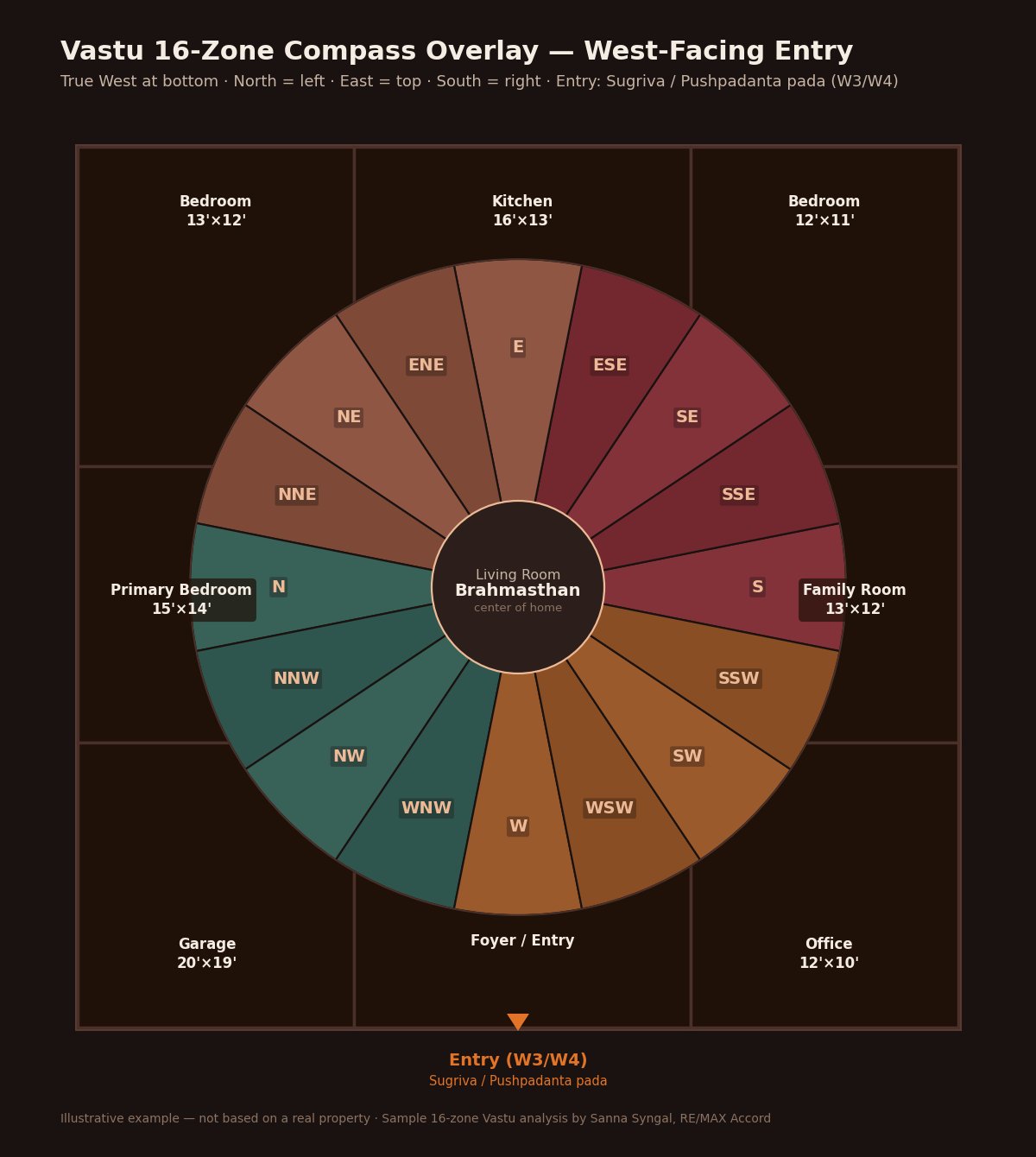
An illustrative example of the 16-zone Vastu map I generate for clients who specifically ask for one. Each direction is divided into two sub-zones — 16 in total, each 22.5° wide. Every room is placed against the grid, and the entry is mapped to its traditional pada. The chart provides data — not a Vastu ruling.
Not the eight basic cardinal directions. Sixteen. Each direction split into two, so instead of "the kitchen is in the southeast," you see the exact sub-zone the kitchen falls in. The entry, the kitchen, the primary bedroom, the other bedrooms, the bathrooms, the northeast corner — every space placed on the grid, measured from the home's true orientation, with the entry mapped to the traditional pada it falls in.
And it is repeatable. I can run it on every home on your tour list and hand you a clean visual report for each one. So you are comparing real placements across homes, not gut-checking a wobbling compass at six different front doors. You can study the report yourself, share it with your family, or pass it to your Vastu consultant for review.
Let me be clear about what this is and is not.
I am not telling you whether a home is auspicious. That is not my expertise or my role. I am replacing a guessing game with a consistent, repeatable measurement — the true facing direction of the home, every important room placed on the grid, the same way for every home you consider. It is far more reliable than a phone compass at the door. But it is not a Vastu ruling, and it is not a legal survey, so I always tell clients to confirm the final read with their consultant.
That honesty is the point. Building this is the part of my practice I am most proud of.
A Note for Feng Shui-Conscious Buyers
Everything above is framed around Vastu, because that is the community I work with most. But the Bay Area also has an enormous Chinese population, and many of those families approach a home search through Feng Shui — the Chinese tradition I mentioned earlier. If that is you, most of this article still applies to you, with one honest distinction.
The measurement problem is identical. Feng Shui, like Vastu, cares deeply about the true facing direction of a home — and just like Vastu buyers, most Feng Shui-conscious buyers and their agents are checking that direction with a wobbly phone compass at the front door, getting readings that are off by enough to matter. Establishing a home's true orientation, from the center, on a stable reference — that helps you exactly the same way it helps a Vastu buyer.
The interpretation is where the traditions diverge, and where I stay in my lane. Feng Shui has its own system — the luopan compass and its 24 directions, and schools of practice like Flying Star — and that interpretation belongs to your Feng Shui consultant, not to me, just as Vastu interpretation belongs to a Vastu consultant. What I can do is the Realtor's half of the job: take your priorities seriously as a real filter, pre-screen homes for orientation before you tour, ask listing agents the right questions, give you accurate directional measurements to work from, and coordinate with your consultant during the contingency period.
So if you are Feng Shui-conscious and buying in the Bay Area, you are as welcome here as my Vastu clients. The respect for the tradition, and the discipline about measuring direction correctly, is the same.
How I Work With Vastu-Conscious Buyers
This is the part of the article that is about me as a Realtor — because if you are reading this, you may be wondering whether I am someone who would actually take this seriously.
Here is how I work:
- I take Vastu seriously as a filter. I don't dismiss it. I don't roll my eyes. I don't tell clients "let's just look at the house first." If a home doesn't meet your core Vastu priorities, we don't tour it. Your time matters.
- I pre-screen the MLS thoughtfully. I use the right tools and data sources to filter homes before I send them to you. You shouldn't have to drive to a home to find out the front door faces the wrong direction.
- I ask listing agents the right questions before tours. A quick call before we drive out can save you a wasted Saturday. The questions I ask most often:
- Which direction does the front door actually face — not which street is it on?
- How is the lot oriented, and is the home set at an angle to the street?
- Is a floor plan available, and can you share it before the tour?
- Where are the kitchen and the primary bedroom within the home?
- Has the home drawn interest from buyers who asked about facing direction?
- I coordinate with your Vastu (or Feng Shui) consultant. If you are working with one, I will schedule tours around their availability, share floor plans and disclosures in advance, and build in time during the contingency period for their review.
- For clients who specifically ask, I run a 16-zone Vastu analysis. Before tours. So you are not guessing at the door. So you have data to make a decision with.
- I respect the line between my role and theirs. I am not the Vastu expert in your home buying journey. Your consultant is. My job is to find homes that fit, ask the right questions, negotiate hard, and hand-hold you through the process from search to close.
My goal is to find you a home that works for your family — financially, practically, and in the ways that matter most to you culturally.
If You're Starting Your Bay Area Home Search
Here is what I would suggest if Vastu (or Feng Shui) matters to your family and you are early in the process:
- Identify a qualified consultant before you start touring homes. Ask people in your community for referrals. Have an initial consultation to understand what is most important for your family.
- Be clear about your non-negotiables. Most of my clients settle on three to four core elements they will not compromise on. Everything else is flexible.
- Work with a Realtor who respects the process — someone who will pre-screen for orientation, ask the right questions before tours, and build consultant timing into the contingency period.
- Don't rely on YouTube and online rules as a checklist. Use them as background context, not as your filter. Let your consultant be your filter.
- Don't trust a quick compass reading at the front door. Measure it the right way — True North, from the Brahmasthan, pointing at the door — or have someone do it with the right tools.
- Start the search with realistic expectations. Bay Area housing stock was not built with Vastu in mind. The right home is out there, but the search takes patience and clear priorities.
Let's Talk About Your Search
If you are buying a Bay Area home with Vastu or Feng Shui in mind, I would love to talk. Whether you are just starting your search, or you have been touring homes and feel stuck, I will hand-hold you through the process — and I will make sure the homes you spend time on actually fit what matters to your family.
Book a 30-minute call →Download the Free Checklist
Download my free 4-Point Vastu Home-Tour Checklist — the essentials to check at every home on one page, plus the 3-step compass method on the back. I'll email it to you, no cost.
Frequently Asked Questions
Is it possible to find a Vastu-compliant home in the Bay Area?
Most Bay Area homes were not built with Vastu Shastra in mind, so finding a fully Vastu-compliant home is uncommon. However, many homes meet the highlights that Vastu-conscious buyers commonly prioritize — entrance direction, kitchen and bathroom placement, master bedroom location, and a clean northeast corner. With careful searching, especially in grid-pattern neighborhoods, buyers can often find homes that meet their core priorities.
Do builders in California build Vastu homes?
No Bay Area builder — tract, custom, or new construction — designs to Vastu principles by default. Lot orientation depends entirely on how the development was platted, not on Vastu considerations.
Should I avoid south-facing or southwest-facing homes?
This is not a question a Realtor should answer for you. Direction preferences in Vastu can depend on factors specific to your family. If Vastu matters to your home search, consult a qualified Vastu professional rather than relying on general online advice.
Can a non-Vastu home be remediated?
Vastu consultants often suggest various remedies for homes that don't fully align with Vastu principles. Whether those remedies work for your family is a question for a qualified consultant, not a Realtor.
Why are most compass app readings wrong inside homes?
Compass apps rely on the phone's magnetometer, which is highly sensitive to nearby metal — appliances, wiring, rebar in the foundation, door hinges, security systems. The threshold of a front door is one of the worst places to take a magnetic reading. Readings can swing 20 degrees or more from the true direction. For a Vastu measurement where each 16-zone sub-zone is only 22.5 degrees wide, that level of error can drop a room into the entirely wrong sub-zone.
What is the Brahmasthan and why does it matter for measuring direction?
The Brahmasthan is the sacred center of the home in Vastu Shastra — literally "the place of Brahma." For checking the facing direction of a home, you measure from the Brahmasthan outward toward the front door, not from the door itself. Measurements taken from the center are less affected by metal in the doorway and give a more accurate read of the home's overall orientation.
Should I use True North or Magnetic North for Vastu measurements?
Vastu practitioners differ on this. Some traditional schools use magnetic north; some modern practice uses true north. I use True North for consistent, repeatable readings — in the Bay Area, magnetic north sits about 13 degrees off from true north, which is more than half of a 16-zone Vastu sub-zone (22.5 degrees each). Whether True or Magnetic is correct for your family's specific Vastu practice is a question for your Vastu consultant.
What is a 16-zone Vastu analysis?
A 16-zone Vastu analysis divides the home into 16 directional sub-zones rather than the basic 8 cardinal directions. Each of the 8 directions is divided into 2 sub-zones, giving 16 zones of 22.5 degrees each. This finer grid lets you see precisely which sub-zone each room falls into — not just "the kitchen is in the southeast" but specifically which sub-zone of the southeast.
When should I bring in a Vastu consultant during the home buying process?
Most clients who work with consultants involve them before making an offer, or during the contingency period after the offer is accepted. The earlier you involve them, the more options you have. After closing, you have already committed to the home, so significant Vastu adjustments become much harder.
What does a Vastu consultation typically cost?
Costs vary widely depending on the consultant, the scope, and whether they review the property in person or remotely. Most clients budget for this as part of their home purchase costs.
Which Bay Area neighborhoods have more Vastu-friendly orientation options?
Vastu friendliness depends on lot orientation, not city. Grid-pattern neighborhoods — parts of Sunnyvale, Santa Clara, and sections of Fremont — tend to offer homes facing all four cardinal directions, giving buyers more options. Curving street layouts in places like Cupertino, Almaden, and Saratoga produce homes facing every angle in between, which can make the search more complex.
Do you work with Feng Shui-conscious buyers too?
Yes. The Bay Area has a large Chinese population, and many families approach a home search through Feng Shui. The directional-measurement discipline is the same — establishing a home's true orientation rather than trusting a phone compass at the door. The interpretation differs (Feng Shui uses its own system, including the luopan compass and 24 directions), and that belongs to your Feng Shui consultant. My role is the same as it is for my Vastu clients: take the tradition seriously as a filter, pre-screen for orientation, ask listing agents the right questions, and coordinate with your consultant.
Do I have to work with a Realtor who understands Vastu?
You don't have to — but it helps. A Realtor who takes Vastu seriously can pre-screen homes for orientation, ask the right questions before tours, and coordinate with your consultant during the contingency period. That saves you time and protects your search from emotional fatigue.
Do you offer Vastu analysis for every home you show?
No. The 16-zone Vastu analysis I run is available on request, case-by-case. Many of my buyers do not follow Vastu, and that is completely fine. But for clients who specifically ask me to check direction — for a home or set of homes — I provide the analysis before tours so they have real data, not guesswork.
Sources
The demographic and market data referenced in this article comes from the following sources:
- Fremont demographics (Asian population, median household income): U.S. Census Bureau, American Community Survey (ACS) 2024 estimates
- Milpitas Asian population share: U.S. Census Bureau ACS 2024
- Cupertino Asian Indian population growth (2000–2010): U.S. Census 2010
- Tracy median home prices ($700K–$750K range, 2026): Zillow Home Value Index and Redfin Data Center, May 2026
- Active "north-facing" / "NE-facing" MLS listing examples: MLSListings, Fremont/Cupertino/Sunnyvale active listings 2026
- Bay Area magnetic declination (~13° E): NOAA NCEI Magnetic Field Calculator, 2026 model