Menlo Park Real Estate in 2026: Prices, Neighborhoods, Schools, Projects, and the Hidden Trade-Offs

Menlo Park's median home sale price was approximately $3.4 million for the three months ending July 2026, with homes receiving about four offers and selling in roughly fifteen days. But the citywide median is a poor way to value an individual Menlo Park property. Recent all-home medians have ranged from roughly $1.4 million in Belle Haven to more than $5 million in Central Menlo on very small samples. Unincorporated West Menlo Park ran around $3.9 million, while one narrower portal-defined "West Menlo" boundary showed a substantially higher median. The map and sample definition matter as much as the headline number. Those are not apples-to-apples markets. The exact address can change the school district, city-versus-county jurisdiction, water and sewer providers, commute, flood and insurance analysis, development rules, and long-term project exposure.
For a buyer, the central question is not simply whether you can afford Menlo Park. It is which version of Menlo Park fits your life. For a seller, the central question is not what the city median did. It is which micro-market, parcel characteristics, and buyer motivations actually determine your home's value.
Menlo Park is one of the most valuable residential locations on the Peninsula, but it is also one of the easiest places to misunderstand.
The city is small in population and enormous in economic influence. Stanford is next door. Sand Hill Road is one of the world's most important venture-capital corridors. Meta's headquarters sits on the Bay side. US-101, Interstate 280, Caltrain, and the Dumbarton corridor create access in four directions. Downtown is quiet and walkable. Mature trees and older homes create an established residential character that is hard to reproduce.
But the name Menlo Park covers dramatically different purchases. A cottage near downtown, a townhouse in Sharon Heights, a detached home in the Willows, a postwar house in Belle Haven, and an estate-sized property in unincorporated West Menlo Park may share a mailing identity while differing on almost every practical factor that matters.
This guide is designed to be the page a short video cannot be: a detailed explanation of Menlo Park's market, history, neighborhoods, schools, commute, infrastructure, flood and insurance questions, buildability, major development projects, and the decisions both buyers and sellers should make before treating the city as one market.
I'm Sanna Syngal, a Realtor with RE/MAX Accord (California DRE #02191250). Before real estate, I worked as an engineer, and I hold a PMP certification. I approach property the same way I approached systems: numbers first, then the story. This article provides general market information, not legal, tax, engineering, insurance, school-placement, or financial advice. Verify property-specific facts with the appropriate district, agency, and professional before acting.
What's in this guide
- What does the Menlo Park video guide cover?
- Is Menlo Park worth its premium in 2026?
- What does a Menlo Park budget actually buy?
- Why is Menlo Park so expensive?
- What is Menlo Park like to live in?
- How did Menlo Park become what it is today?
- What are the five buyer markets inside Menlo Park?
- What is each Menlo Park neighborhood actually like?
- Which Menlo Park addresses are not in the City of Menlo Park?
- How does the Menlo Park school map work?
- What is the commute really like?
- Flood, earthquakes, drainage, trees, and insurance
- Can you add an ADU or expand the house?
- Which projects could reshape Menlo Park?
- What housing and tenant rules changed in 2026?
- How would I buy a home in Menlo Park?
- How would I prepare and sell a Menlo Park home?
- Who is Menlo Park right for?
- Frequently asked questions
What does the Menlo Park video guide cover?
The video runs about fifteen minutes and gives you the framework. This article goes further: individual neighborhood profiles, the history behind the city’s layout, seller-specific advice, additional public projects, and a deeper parcel-level diligence checklist.
Prefer YouTube? Watch the Menlo Park guide here.
Key takeaways
- Menlo Park is not one housing market. The citywide median was about $3.4 million in the three months ending July 2026, but different neighborhoods, property types, jurisdictions, and school systems trade on different logic.
- The premium is structural. What many buyers are purchasing is time: shorter recurring trips to Stanford, Palo Alto, Sand Hill Road, Meta, Caltrain, US-101, Interstate 280, and the Dumbarton corridor.
- A Menlo Park mailing address is not always the City of Menlo Park. West Menlo Park, Menlo Oaks, Weekend Acres, and other unincorporated pockets follow San Mateo County rules.
- The school map is more important than the city map. Most addresses fall within Menlo Park City, Las Lomitas, or Ravenswood for TK-8, while a small unincorporated area along Middlefield Road with Menlo Park mailing addresses is served by Redwood City School District. High school assignment runs through Sequoia Union and must be verified by address.
- Regional access is excellent; local circulation can be frustrating. Four Caltrain crossings remain at grade, Express trains skip the Menlo Park station entirely, and a short distance can still produce a difficult commute.
- A large lot is not automatically a buildable lot. Setbacks, easements, floor-area limits, protected trees, drainage, flood rules, utilities, geology, fire access, and city-versus-county authority can all change the answer.
- The city is entering a major development cycle. Parkline, 80 Willow Road, 345 Middlefield Road, Willow Village, the downtown parking plazas, SB 79, rail projects, and SAFER Bay could reshape different parts of Menlo Park on very different timelines.
- Sellers should price the address, not the city. The right competitive set usually depends on neighborhood, school configuration, jurisdiction, housing type, lot profile, condition, commute, and project exposure—not the Menlo Park median.

Is Menlo Park worth its premium in 2026?
Menlo Park's premium is real, but whether it is worth paying depends on how much value the buyer receives from the exact location, not from the city name.
According to Redfin's Menlo Park market data, the median sale price across all home types was approximately $3.40 million for the three months ending July 2026, up 17.2% from the same period a year earlier. Homes received about four offers and sold in approximately fifteen days. The typical sale was around 2% above list price, while the hottest properties could trade materially higher.
Those numbers show strong demand. They do not tell you what one house is worth.
During the same period, the reported median sale price per square foot fell about 22% even as the headline median rose 17%. That apparent contradiction is a warning about mix effect. If a month contains more large renovated houses, more attached homes, more Belle Haven sales, or one or two ultra-luxury closings, the median can move without every comparable home moving in the same direction.
The neighboring cities reinforce the point. Over the same three months, Palo Alto's all-home median slipped about 1.5% and Los Altos fell about 2.8%, while Allied Arts, inside Menlo Park, was down roughly 18.6%. A city that is “up 17%” while its neighbors are flat and one of its own neighborhoods is down is a city whose sales mix shifted, not one where every house gained a sixth of its value.
Menlo Park magnifies that problem because many neighborhoods have very few monthly sales. A published neighborhood median may represent one, four, nine, or fifteen transactions. One new construction sale or one unusually large lot can swing it by millions.
What the citywide number hides
Recent reported all-home medians illustrate the spread:
| Area | Recent directional median | What the number does and does not mean |
|---|---|---|
| Belle Haven | About $1.45M | A useful indication of the city's lower detached-home entry point; only seven July sales in the reported period |
| Allied Arts | About $2.44M | Based on only four July sales; unusually sensitive to property type, condition, and one-off transactions |
| West Menlo Park CDP | About $3.89M | Unincorporated county market; thirteen July sales and a different government, school, lot, and service map |
| Portal-defined “West Menlo” | About $5.40M | A narrower real-estate portal boundary with only eight July sales; may track the City's incorporated “West Menlo” neighborhood rather than the county CDP; not interchangeable with the full West Menlo Park CDP |
| Central Menlo | About $5.10M | Only nine July sales and strongly affected by larger, renovated, or prime-location homes |
| Menlo Park citywide | About $3.40M | Eighty-one July sales across all property types and submarkets; useful for context, not individual valuation |
The purpose of that table is not to claim that otherwise identical homes differ by four million dollars. They do not. The point is that the label Menlo Park combines unlike inventory.
For buyers, the implication is simple: do not apply a citywide appreciation rate, sale-to-list ratio, or price per square foot to a specific property. Compare the home with sales from the same micro-market, similar school configuration, same jurisdiction, similar housing type, lot profile, condition, and exposure to traffic or future development.
For sellers, this is equally important. A listing strategy built around the city median can underprice a highly scarce property or overprice a home whose drawbacks are not visible in a broad statistic. Your buyer pool is not “everyone looking in Menlo Park.” It is the narrower group for whom your location, commute, school map, lot, and house type solve a particular problem.
How does Menlo Park compare with nearby cities?
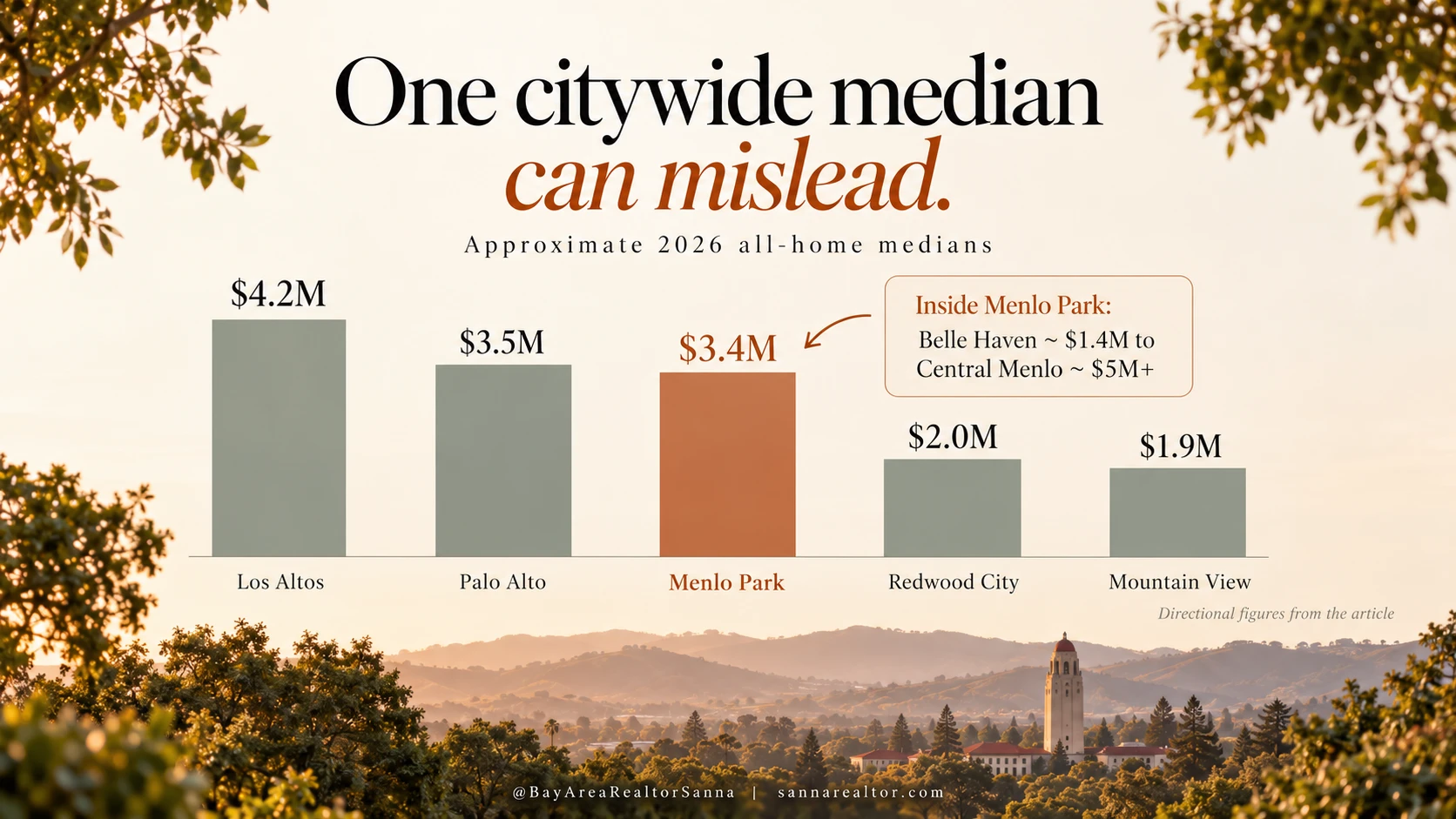
The following all-home medians provide regional context, not an apples-to-apples valuation model:
| City | Approximate recent all-home median, 2026 | Broad buyer trade-off |
|---|---|---|
| Los Altos | About $4.2M | More consistently residential and often larger-lot oriented; no Caltrain station |
| Palo Alto | About $3.5M | More urban energy and direct Stanford identity; equally fragmented and expensive |
| Menlo Park | About $3.4M | Central Peninsula access, Sand Hill/Stanford/Meta proximity, quiet downtown, varied submarkets |
| Redwood City | About $2.0M | More housing variety and a larger downtown at a lower entry point |
| Mountain View | About $1.9M | Strong transit and employment access with more attached inventory and a different commute pattern |
A buyer should not read this as “Menlo Park is cheaper than Palo Alto, therefore it is a bargain,” or “Menlo Park is more expensive than Redwood City, therefore it is overpriced.” The real comparison is:
- What recurring trips does each address eliminate?
- What type and condition of home does the budget buy?
- Which school, jurisdiction, and property-risk profile comes with it?
- How much liquidity remains after closing for renovation, maintenance, taxes, insurance, or an ADU?
That is how a price comparison becomes a purchasing decision.
What does a Menlo Park budget actually buy?
The realistic entry point changes more by housing type and submarket than by the citywide median. The following bands are directional, not promises of current inventory. Menlo Park's supply is thin, and one block, school boundary, remodel, or lot can move a property far outside the range.
| Approximate budget | What buyers may encounter | Common compromise |
|---|---|---|
| Under $2M | Condos and townhomes; smaller or dated detached homes in Belle Haven; unusual properties needing substantial work | HOA, house size, condition, school district, freeway or flood diligence |
| $2M-$3M | Attached homes in central or western areas; smaller detached homes in east-central neighborhoods; renovation opportunities | Lot size, functional obsolescence, busy-street exposure, or major capital work |
| $3M-$4M | A broader set of detached homes in the Willows, Suburban Park, South of Seminary, Downtown/Allied Arts pockets; some Sharon Heights options | Renovation level, exact street, school configuration, train or arterial exposure |
| $4M-$6M | Renovated detached homes, larger lots, prime central locations, West Menlo opportunities, higher-end Sharon/Stanford-side homes | Paying a significant premium for address, lot, and condition rather than pure square footage |
| $6M+ | Larger new or comprehensively remodeled homes, prime streets, exceptional lots, estate-oriented properties | Low sales volume makes valuation highly property-specific |
Three cautions matter here.
First, attached inventory changes the entry point. A Sharon Heights townhouse, downtown condo, or newer attached home can offer Menlo Park access at a price far below a detached-home median, but the HOA's reserves, insurance, litigation, maintenance obligations, rental rules, and planned assessments become part of the investment.
Second, a lower purchase price can hide a higher total project cost. A two-and-a-half-million-dollar house needing a roof, foundation work, drainage correction, electrical service upgrade, window replacement, kitchen, baths, and an addition may be a more expensive decision than a renovated house listed substantially higher.
Third, approval is not buildability. A buyer may be financially approved for the purchase but not have enough cash, time, or risk tolerance to execute the renovation the property needs. In Menlo Park, the cleanest-looking bargain is sometimes simply the house whose deferred work has not yet been priced correctly.
Why is Menlo Park so expensive?

Menlo Park is best understood as a time market: buyers pay to compress the distance between home and the places that organize their lives.
The premium is structural rather than purely aesthetic.
- Stanford University, Stanford Hospital, and Stanford Shopping Center sit immediately to the south.
- Sand Hill Road connects Menlo Park with one of the world's densest concentrations of venture-capital firms and the west-side employment corridor.
- Meta's headquarters and the Willow Road employment area anchor the eastern side.
- Palo Alto and Redwood City are on either side, extending the dining, medical, retail, and employment ecosystem.
- US-101, Interstate 280, Caltrain, and the Dumbarton corridor give access north, south, west, and toward the East Bay.
The scarce asset is not only the land. It is the possibility of removing hundreds of hours of recurring travel over a year.
But proximity is valuable only when it matches the buyer's real calendar. The best Menlo Park neighborhood for a Sand Hill Road commute may not be the best for Caltrain. The best for Meta may not be the best for Interstate 280. A two-income household can have two incompatible “perfect” locations.
Start with two destinations, not one dream house
Before choosing a neighborhood, write down:
- The two places each adult travels most often.
- The days and times those trips occur.
- School, childcare, medical, and family routes that repeat weekly.
- Whether Caltrain use is occasional, regular, or essential.
- Whether the East Bay is part of the routine.
- Which trip becomes unacceptable if traffic adds twenty minutes.
Then test the actual address at the actual time.
A six-mile Bay Area commute is not automatically short. A home may look close to Stanford but sit on the wrong side of a rail crossing. It may appear close to 101 but require a difficult left turn onto a backed-up arterial. It may be ideal for 280 and poor for Caltrain.
This is Menlo Park's local traffic paradox: regional access is excellent, while local circulation can be frustrating. The city is crossed by Caltrain, El Camino Real, US-101, Willow Road, Ravenswood Avenue, and other high-demand routes. The exact street can matter as much as the neighborhood name.
For sellers, commute is one of the strongest ways to explain value. Do not market only “minutes to everything.” Show the actual advantage: walk time to Caltrain, bike route to Stanford, route to Sand Hill without crossing downtown, access to 280, or proximity to the Meta corridor. Buyers pay more confidently for a benefit they can picture repeating.
What is Menlo Park like to live in?
Menlo Park is a calm, understated daily-life city rather than a major nightlife or entertainment destination. That is either its limitation or its appeal, depending on the buyer.
Downtown centers on Santa Cruz Avenue and the surrounding blocks. The city offers a Sunday farmers market, the restored Guild Theatre as a live-performance venue, the main library, Fremont Park, Burgess Park, recreation facilities, cafés, restaurants, and locally oriented retail. Springline added a newer mixed-use district near El Camino Real and the station, with 183 homes and approximately 220,000 square feet of commercial uses.
The west side has easy access to Stanford, Sharon Park, neighborhood shopping, and the trails and open-space network toward the foothills. The east side has Bedwell Bayfront Park, the Ravenswood Open Space Preserve area, the Meta campus, and the Belle Haven Community Campus. Completed in 2024, that campus combines a library, pool, gymnasium, youth and senior spaces, community rooms, a makerspace, and event facilities. It later earned LEED Platinum certification.
Allied Arts Guild, founded in 1929, remains one of Menlo Park's most distinctive cultural spaces: Spanish Colonial-style buildings, gardens, working studios, shops, and a history of supporting Lucile Packard Children's Hospital Stanford.
The practical lifestyle benefit is not that Menlo Park contains every amenity. It is that it places a quiet residential base between multiple amenity centers. Downtown Palo Alto, Stanford Shopping Center, Redwood City, the foothills, and the Bay are all close enough to become part of ordinary life.
What Menlo Park does not offer
Buyers should be equally honest about what is missing.
- Downtown is pleasant but modest; it does not have Redwood City's scale or Palo Alto's continuous activity.
- Many neighborhoods are car-oriented despite the city's central location.
- Nightlife is limited.
- East-west movement can be interrupted by tracks, El Camino Real, and Highway 101.
- The city's identity is not uniform: Belle Haven, Sharon Heights, the Willows, downtown, and West Menlo function differently.
Menlo Park is often a daily-life purchase, not a destination purchase. The right buyer values calm streets, proximity, parks, and routine convenience more than a constant stream of urban activity.
How did Menlo Park become what it is today?
Menlo Park's present-day patchwork makes more sense when you see it as layers: Indigenous land, a Spanish-era rancho, a railroad settlement, a World War I camp, a suburban city, a research center, and a global technology and finance hub.
Long before there was a city, the Peninsula was home to Indigenous Ohlone communities. Under Spanish and Mexican rule, the area became part of the Rancho de las Pulgas land grant, whose name survives across the Peninsula in streets and local geography.
In 1854, Irish immigrants Dennis J. Oliver and D. C. McGlynn acquired land along what is now El Camino Real and placed a large wooden gate at the entrance to their estate. The gate read “MENLO PARK,” named for Menlough in County Galway, Ireland. When the railroad reached the community in 1863 and needed a station name, it adopted the words already visible at the gate. That is how a private estate name became a city identity.
The railroad shaped downtown. Commercial activity formed between the station and El Camino Real, while residential areas spread around it. Menlo Park briefly incorporated in 1874 as part of a much larger area that included places later known as Atherton and East Palo Alto, then dissolved that incorporation in 1876. The current city was incorporated on November 23, 1927.
World War I created another major turning point. Camp Fremont brought tens of thousands of soldiers to the area beginning in 1917. Local historians credit the Army's presence with Menlo Park's first paved streets and municipal water and gas service, and according to the City, the base hospital built on Willow Road later became the site of the Veterans Administration medical center. The camp's footprint also helps explain why military and postwar history appear across neighborhoods that otherwise feel purely suburban today.
In 1929, Allied Arts Guild began transforming part of the old rancho landscape into an arts compound. After World War II, Menlo Park grew through the same postwar housing forces that shaped much of the Peninsula: ranch houses, subdivisions, schools, roads, and expanding commuter patterns.
Then came the research economy. SRI's Menlo Park campus served as its home beginning in 1947. Work associated with the campus helped pioneer the internet, the computer mouse, mobile robotics, and other foundational technologies. In August 2026, SRI announced that it would relocate its headquarters and Silicon Valley teams to its PARC campus in Palo Alto—a historic institutional departure tied to the proposed Parkline redevelopment of the 64-acre Ravenswood site.
Sand Hill Road's rise as a venture-capital center and Meta's growth on the Bay side created the modern economic identity. Menlo Park became a small city with outsized global influence: part college town, part research center, part suburban enclave, part technology headquarters, and part gateway between the Peninsula and East Bay.
Why the history matters to real estate
This is not simply background material. History affects the product buyers encounter:
- Railroad proximity created walkability and train exposure in the central neighborhoods.
- Camp Fremont and postwar growth contributed older infrastructure and a wide range of housing ages.
- The rancho and semi-rural legacy survive in mature trees, irregular lots, and unincorporated pockets.
- Research and technology campuses created large parcels now being reconsidered for housing.
- Historical resources can affect redevelopment, as the former Sunset Magazine property at 80 Willow Road demonstrates.
Menlo Park's current development debate is not random. It is the latest transition in a place that has repeatedly converted land from one dominant use to another.
What are the five buyer markets inside Menlo Park?
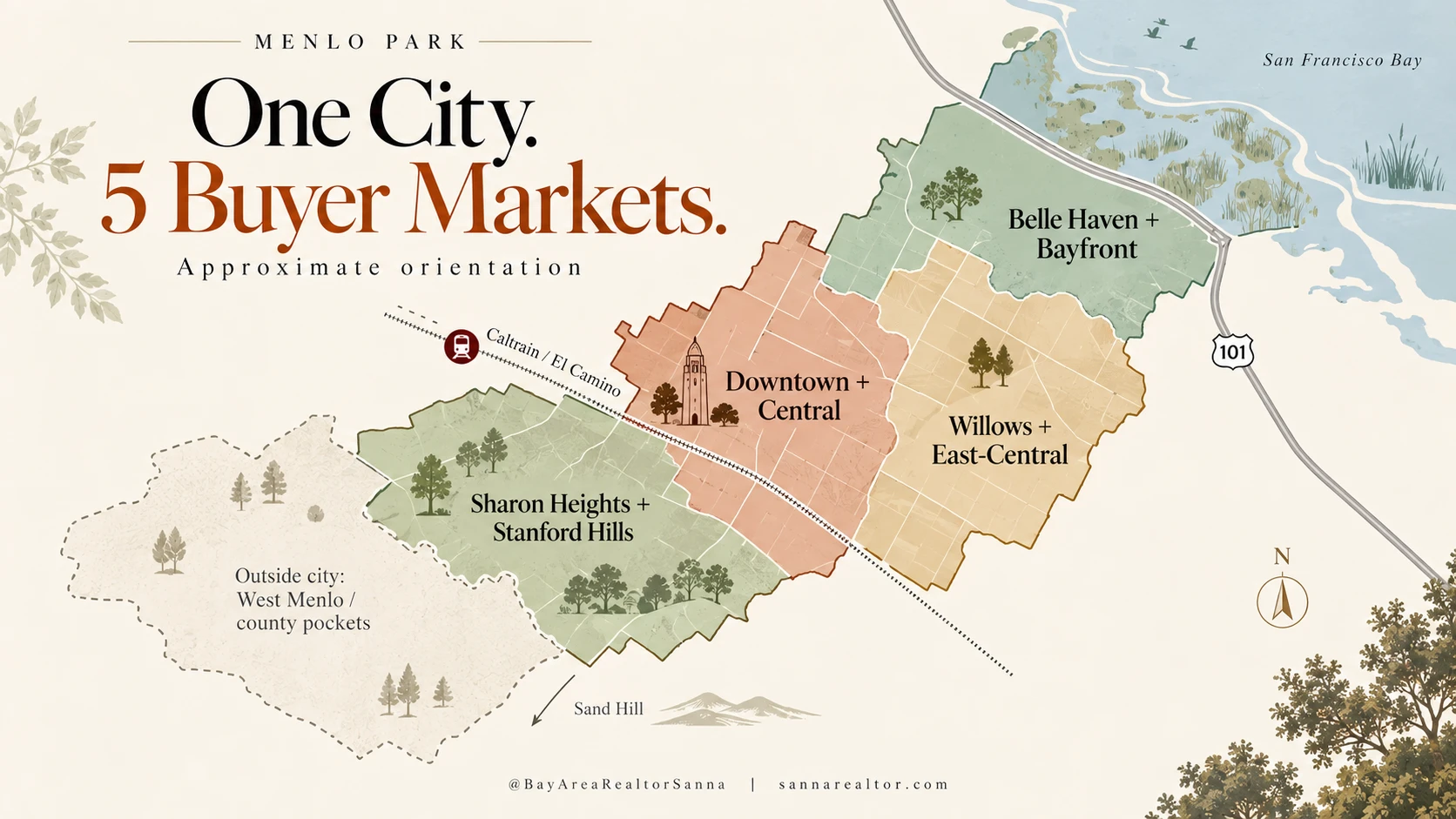
For buying and selling purposes, Menlo Park is easier to understand as five overlapping markets rather than one city. These are analytical categories, not official planning districts. Neighborhood names and boundaries vary among residents, listing services, and city maps.
| Buyer market | What the buyer is mainly purchasing | Core trade-off |
|---|---|---|
| 1. Downtown and central pockets | Walkability, Caltrain, Stanford/Palo Alto proximity, established streets | Convenience premium, train and arterial exposure, future downtown density |
| 2. The Willows and east-central neighborhoods | Palo Alto and Willow Road access, detached homes, remodel and lot potential | Cut-through traffic, older housing systems, street-by-street variation |
| 3. Sharon Heights and Stanford Hills | Sand Hill, 280, Stanford, wooded setting, attached and detached options | Less downtown integration, slope, trees, HOA and car dependence |
| 4. Belle Haven and the Bayfront side | Lower detached-home entry point, Meta/101/Dumbarton access, new public investment | Highway separation, Ravenswood schools, flood and project-timeline diligence |
| 5. Menlo Park addresses outside the city | Premium west-side locations, county-governed parcels, often larger or distinctive lots | Different government, zoning, permits, services, and sometimes school systems |
This framework prevents the most expensive category error in the city: assuming two properties are substitutes because both listings say Menlo Park.
What is each Menlo Park neighborhood actually like?
The neighborhood decision should be based on commute, housing type, exact street, jurisdiction, school configuration, and property condition—not a reputation ranking. The descriptions below focus on physical and practical differences. They are not judgments about the people who live in any area.
Downtown Menlo Park
Best fit
Buyers who want to walk to Santa Cruz Avenue, Caltrain, cafés, the farmers market, libraries, and daily errands.
Downtown offers the clearest version of Menlo Park's limited but meaningful urban lifestyle. Housing includes older detached homes, cottages, duplex-style properties, condos, townhomes, and newer mixed-use inventory near El Camino Real. A buyer may be able to reduce car use in a way that is difficult in Sharon Heights or the Bayfront area.
The premium is convenience, not necessarily lot size. The exact block matters because rail noise, horns, gate closures, El Camino traffic, Ravenswood traffic, and commercial activity can change within a short walk. Not every buyer experiences those factors as negative; the point is to visit at the times they occur.
Downtown also carries more long-term land-use uncertainty than many residential neighborhoods. SB 79 now affects qualifying sites near the Caltrain station. The City is evaluating housing on Parking Plazas 1, 2, and 3, and a November 2026 ballot measure could require voter approval before those lots change. Springline has already changed the El Camino/station edge. A buyer should map the home against existing parking lots, approved projects, and the half-mile transit area rather than assuming today's low-rise pattern is permanent.
Seller lens
Quantify walkability. Show the actual route and time to Caltrain, Santa Cruz Avenue, parks, and schools. At the same time, disclose and price train or traffic exposure honestly. Buyers will discover it; the listing strategy is stronger when the convenience case is specific and credible.
Central Menlo
Best fit
Buyers seeking the established, central residential experience associated with classic Menlo Park, with access to downtown, Stanford, and central Peninsula schools and services.
“Central Menlo” is used broadly and can overlap with Allied Arts, downtown, and other local labels. The housing stock includes early- and mid-century homes, extensively remodeled properties, and large newer rebuilds. Mature landscaping and a low-rise streetscape are major parts of the appeal.
This is often a lot-and-location market. Two houses with similar interior square footage may command very different prices because one has a wider parcel, better backyard orientation, quieter block, stronger indoor-outdoor connection, more functional expansion history, or cleaner permit file.
The premium creates its own risk: buyers can overpay for finishes that are easy to reproduce while underestimating elements that are not—street position, lot geometry, tree placement, or walkability. A beautiful kitchen should not distract from an awkward floor plan, a low ceiling height, poor daylight, or expensive structural limitations.
Seller lens
The strongest central Menlo listing is not simply staged well. It explains scarcity: lot width, privacy, street, school verification, permitted square footage, usable yard, renovation quality, and route to daily destinations. Permit documentation and a clear improvement timeline can materially improve buyer confidence.
Allied Arts and Stanford Park
Best fit
Buyers who value proximity to Stanford, downtown Menlo Park, Palo Alto, biking, and a neighborhood with older architectural character.
Allied Arts sits near the Stanford border and takes its name from the Allied Arts Guild. The area offers cottages, bungalows, period-inspired homes, remodeled properties, and newer construction on relatively intimate streets. For some households, the ability to reach Stanford, downtown Menlo Park, and Palo Alto without a long freeway trip is the entire purchasing thesis.
The neighborhood's charm can create competition for imperfect homes. Buyers should distinguish between cosmetic age and structural or functional limitations. Older houses may have small bedrooms, limited closets, dated foundations, knob-and-tube remnants, undersized electrical service, drainage issues, or additions completed under different standards.
Properties closer to El Camino Real, Sand Hill Road, or the rail corridor can feel different from interior blocks. School and jurisdiction assumptions should still be verified from the address.
Seller lens
Preserve what makes the house distinctive. Over-modernizing an older home can erase character without solving the expensive systems. A targeted plan—systems, light, flow, landscaping, and documentation—often creates more value than replacing every visible finish.
Linfield Oaks
Best fit
Buyers wanting central access, Burgess-area amenities, Palo Alto proximity, and a residential setting east of the tracks.
Linfield Oaks lies near several of the city's most important transition sites. The former Sunset Magazine headquarters at 80 Willow Road is in the neighborhood. The former USGS campus at 345 Middlefield is nearby. Parkline will reshape the SRI property along Ravenswood if its next phases proceed. That makes Linfield Oaks a useful case study in Menlo Park's future: established homes next to large parcels being reconsidered for substantially more housing and mixed use.
Day to day, the area benefits from proximity to Burgess Park, the library, schools, Middlefield Road, Willow Road, downtown, and Palo Alto. It also requires careful attention to rail crossings, traffic routes, project construction horizons, and what an approved or proposed development actually includes.
A project several blocks away is neither automatically harmful nor automatically valuable. It can add open space, retail, housing, improved streets, and activity, while also creating years of construction, altered views, or new traffic. The answer depends on the specific home and project edge.
Seller lens
Do not ignore major projects in the disclosure and marketing strategy. Prepare a factual map and timeline. Separate what is completed, approved, under review, and paused. Buyers are more comfortable with change when the seller presents verified information instead of avoiding the subject.
Felton Gables
Best fit
Buyers seeking a small, distinctive enclave with central access and a more secluded residential feel.
Felton Gables is a compact neighborhood, and inventory can be extremely limited. Its appeal comes from scarcity, mature landscaping, and proximity to downtown and the Atherton border; the enclave sits north of Encinal Avenue, east of El Camino Real, with the Caltrain tracks on its western edge. Because there are few transactions, neighborhood-level statistics can be misleading.
The right valuation usually depends on a broader but carefully adjusted competitive set: lot, street, house age, renovation, school configuration, and proximity to rail or major routes. Do not force a price-per-square-foot model onto a property merely because the neighborhood had too few recent sales.
Seller lens
Scarcity can justify a premium, but only when buyers understand what is scarce. Use a narrative supported by parcel facts, not an unsupported “rare opportunity” label.
The Willows
Best fit
Buyers who prioritize Palo Alto access, Willow Road, a strong neighborhood identity, detached-home inventory, and long-term improvement potential.
The Willows is one of the most recognizable Menlo Park neighborhoods. It contains a mix of early twentieth-century homes, bungalows, period revival styles, postwar ranch homes, remodels, and rebuilds. Mature trees and relatively consistent residential scale give many blocks a cohesive feel even though the houses vary.
Its location is the advantage and the complication. Palo Alto and Highway 101 can be close, while Willow Road, Middlefield Road, Ravenswood Avenue, and neighborhood cut-through patterns can affect individual streets. A quiet weekend showing may not reveal weekday queues, school traffic, or the difficulty of turning left from a driveway.
Older houses can offer useful land value, but the improvement analysis must include foundation, roof, drainage, electrical capacity, sewer lateral, tree position, and what the floor-area and setback rules allow. A home that looks like a simple remodel can become a reconstruction once those systems are priced.
Seller lens
Buyers often enter the Willows with a mental comparison to Palo Alto. Position the home around commute, street, lot usability, and future potential, but do not overstate ADU or expansion options. A preliminary feasibility review can convert vague potential into defensible value.
Suburban Park and Lorelei Manor
Best fit
Buyers looking for postwar detached housing, access to Marsh Road and US-101, and a residential neighborhood with a different price-to-space equation from central Menlo.
These areas include a meaningful concentration of ranch-style and postwar homes. Many properties have straightforward footprints that can work well for renovation, while others have accumulated piecemeal additions. The value often depends on whether prior improvements created a coherent plan or simply more square footage.
Flood Park and nearby open space are local assets. Marsh Road and 101 access can be practical for north-south commuters. The trade-off is that freeway access routes and cut-through traffic require street-level testing.
Because many homes share an era and original form, buyers compare renovation quality closely. A seller may compete against properties with similar exteriors but dramatically different systems and permits.
Seller lens
Document the invisible work. A newer roof, upgraded panel, sewer replacement, drainage, seismic work, insulation, HVAC, windows, and permitted addition may matter more than another round of decorative staging in a neighborhood where buyers can compare similar houses.
South of Seminary, Vintage Oaks, and the Flood Park area
Best fit
Buyers seeking east-central access, neighborhood-scale parks, and a mix of home sizes and renovation opportunities.
These labels overlap in common usage, and exact boundaries vary. The broader area sits between central Menlo Park, Redwood City, Middlefield Road, and the Marsh/101 network. That creates flexible access but also highly localized traffic patterns.
Housing can range from modest postwar properties to substantially expanded homes. Some streets feel tucked away; others carry more vehicle movement. Buyers should drive the route to both 101 and downtown, observe school and commute periods, and examine drainage around the exact lot.
The area's proximity to the former USGS campus means the 345 Middlefield proposal belongs on the project map. The proposal remains under review, and its final form and timing are not guaranteed.
Seller lens
Define the neighborhood through the buyer's route and use case rather than relying on a label every buyer may interpret differently.
Menlo Oaks
Best fit
Buyers attracted to a tree-filled, less conventional residential setting who are comfortable with San Mateo County jurisdiction and parcel-specific infrastructure.
Menlo Oaks is within Menlo Park's sphere of influence but includes unincorporated county territory. That distinction changes the permitting authority, zoning framework, and possibly service arrangements. The neighborhood can feel more rural or irregular than the incorporated city's conventional subdivisions, with mature trees and varied parcels.
The first diligence question is not architectural style. It is jurisdiction. The second is infrastructure: water, sewer, drainage, access, and any private or shared conditions attached to the parcel.
Seller lens
County-governed property should be marketed with a clean jurisdiction and service summary. Ambiguity reduces buyer confidence; verified differences can become a feature when explained correctly.
Sharon Heights
Best fit
Buyers whose lives are organized around Sand Hill Road, Stanford, Interstate 280, or the western Peninsula—and buyers open to both detached homes and attached communities.
Sharon Heights feels different from downtown Menlo Park. The setting is more wooded and topographically varied. Housing includes detached homes, townhomes, condominiums, and planned communities. Sharon Park, neighborhood shopping, and direct access toward 280 and Sand Hill are central to the lifestyle.
The trade-off is reduced integration with Caltrain and Santa Cruz Avenue. Many daily trips require a car. For attached properties, the HOA can be as important as the unit: reserves, insurance, roof and exterior responsibility, drainage, private roads, retaining walls, landscaping, rental restrictions, litigation, and special-assessment risk.
For detached homes, slope, drainage, retaining structures, wildfire-adjacent vegetation, mature trees, and foundation conditions deserve closer attention than they might on a flat central lot. Views and privacy can add value, but they may come with higher maintenance and more complex construction.
Seller lens
For an attached home, assemble the HOA package early and address known questions before launch. For a detached home, provide drainage, retaining-wall, roof, and arborist documentation when available. Western buyers often pay for a low-friction ownership story.
Stanford Hills
Best fit
Buyers wanting a quiet Stanford/280-side location, larger or more secluded parcels, and access to the Las Lomitas side of the school map where applicable.
Stanford Hills is a location-driven market with limited inventory and strong parcel variation. Topography, trees, lot orientation, access, and existing house placement can matter more than a simple interior-size comparison.
A flat, usable lot and a sloped parcel with the same recorded acreage are not economically identical. Buyers considering major work should understand the geotechnical, drainage, access, tree, and construction-logistics implications before assigning value to theoretical expansion.
Seller lens
Survey, site plan, geotechnical history, drainage improvements, and tree documentation can be unusually valuable. Buyers need to understand how much of the land is practically usable.
West Menlo Park and University Heights
Best fit
Buyers seeking premium west-side access, established streets, Stanford and 280 proximity, and county-governed property.
The central fact is easy to miss: West Menlo Park is not the City of Menlo Park. It is an unincorporated San Mateo County community with a Menlo Park mailing address. County planning and building rules apply. School and service boundaries must be confirmed independently.
The housing market often trades at the upper end because of location, lots, schools, and limited supply. But the neighborhood median can be volatile, and it should not be used to value a unique property without adjusting for lot, age, renovation, street, and jurisdiction.
One more source of confusion: the City's official neighborhood map also has an incorporated neighborhood named simply “West Menlo,” lying west of downtown inside city limits. A listing portal that uses a “West Menlo” boundary may be describing that incorporated area, the unincorporated CDP, or a blend of the two. Confirm which side of the city line a specific address falls on rather than relying on the label.
University Heights and adjacent labels can overlap with the West Menlo identity. Some blocks are close to shops and restaurants along the Alameda de las Pulgas/Santa Cruz Avenue area; others are more purely residential. The appeal is often a west-side daily-life pattern rather than downtown Caltrain access.
Seller lens
County permit records, square footage, school verification, and utility details should be organized before the listing. Do not assume buyers understand why the county jurisdiction matters—or that they will view it negatively. Explain the actual differences.
Weekend Acres and the West Menlo Triangle
Best fit
Buyers comfortable with small unincorporated pockets and the need to verify governance rather than rely on a map label.
Weekend Acres is another unincorporated area within Menlo Park's sphere of influence. The West Menlo Triangle is an approximately fourteen-acre unincorporated residential pocket containing about sixty single-family homes near Santa Cruz Avenue, Alameda de las Pulgas, and Sharon Road. In 2026, the City was exploring annexation and waived certain processing fees, but exploration is not annexation. Until a process is completed, county governance remains the starting point.
Annexation can potentially change municipal services, rules, taxes or assessments, representation, and permitting relationships. Buyers and sellers should verify the current status at the moment of a transaction rather than rely on the last public meeting summary.
Seller lens
If annexation is being discussed, disclose the process factually and avoid promising either outcome or financial effect.
Belle Haven
Best fit
Buyers seeking Menlo Park's most accessible detached-home entry point, proximity to Meta and the Dumbarton/101 corridor, and a community experiencing substantial public investment.
Belle Haven sits east of Highway 101 and functions differently from central Menlo Park. Housing is often smaller and more postwar in character than the large renovated homes associated with the city's western side. That difference in product, school district, geography, and infrastructure helps explain the price gap.
The neighborhood's advantages are real: access to Meta, Willow Road, 101, the Dumbarton corridor, Bedwell Bayfront Park, and the Belle Haven Community Campus. The new campus is one of the city's most significant completed public investments.
The trade-offs are equally real. Highway 101 separates Belle Haven from central Menlo Park. The area is served by Ravenswood City School District for TK-8 rather than Menlo Park City School District. Flood, drainage, sea-level-rise, and insurance diligence deserve particular attention. Willow Village's pause also matters because planned retail, a grocery store, pharmacy services, parks, and housing are not arriving on the original assumed schedule.
None of those facts mean Belle Haven is a uniform market. Street, remodel quality, lot, flood designation, proximity to traffic, and project location still matter property by property.
Seller lens
Do not market only the Menlo Park name. The strongest case is specific: commute to Meta or the East Bay, community-campus access, detached-home entry point, improvements, lot utility, and verified flood/insurance information.
The Bayfront side
Best fit
Buyers and investors focused on employment access, large-scale land-use change, shoreline open space, and a long-term rather than fixed-timeline thesis.
The Bayfront contains office, research, industrial, institutional, and open-space uses alongside the Willow Village area and other development sites. It is where Menlo Park's economic and environmental future collide most visibly.
Willow Village is approved but paused. SAFER Bay is in planning and design, with construction dependent on funding. Major transportation and resilience improvements are long-term. That means the area offers optionality but limited certainty.
A buyer should not pay today's price for tomorrow's grocery store, park, town square, flood-wall completion, or transit improvement unless that amenity exists or the risk is explicitly priced. At the same time, dismissing every project because it is delayed ignores the scale of public and private investment under consideration.
Seller lens
Label every nearby item accurately: completed, under construction, approved, under review, funded, unfunded, or paused. Those distinctions are part of value.
Which Menlo Park addresses are not in the City of Menlo Park?
A Menlo Park mailing address is not proof that a property is governed by the City of Menlo Park. This is one of the most consequential facts a buyer or seller can miss.
San Mateo County's Local Agency Formation Commission identifies unincorporated communities within Menlo Park's sphere of influence, including West Menlo Park, Menlo Oaks, Weekend Acres, and the SLAC area east of Interstate 280. The sphere of influence is a long-range planning boundary. It does not place those properties inside the city today.
The distinction changes which government answers basic property questions.
| Question | Incorporated Menlo Park | Unincorporated Menlo Park-address property |
|---|---|---|
| Planning and zoning | City of Menlo Park | San Mateo County |
| Building permits and records | City building division and online permit system | County planning and building systems |
| Tree, grading, and development review | City rules and departments | County rules and departments |
| Local ordinances | City ordinances may apply | County rules apply unless another district has authority |
| Roads and public improvements | City or another identified agency | County, private, or district responsibility depending on the road |
| Schools | Still parcel-specific; city limits do not set school districts | Parcel-specific and separately verified |
| Water and sewer | Provider varies by address | Provider also varies; county location does not answer it |
County governance is not automatically an advantage or disadvantage. It is a different legal and administrative system. A large unincorporated lot may look more flexible but can carry distinct setbacks, tree review, drainage, access, utility, or permit requirements. Conversely, a city parcel may have a clearer municipal process but more local standards or fees.
Why the APN matters more than the mailing city
The Assessor's Parcel Number, or APN, is the most reliable starting identifier. A serious property review should use the APN to confirm:
- city or county jurisdiction;
- zoning and general-plan designation;
- school districts;
- water, sewer, fire, and other service districts;
- flood, creek, slope, or other applicable overlays;
- permit records and legal improvements; and
- whether any annexation or boundary process is actually complete.
What about the West Menlo Triangle annexation discussion?
The West Menlo Triangle is a small unincorporated pocket near Santa Cruz Avenue, Alameda de las Pulgas, and Sharon Road. Menlo Park has explored annexation and, in 2026, took steps intended to reduce application costs. That does not make the area part of the city today.
An annexation can affect government representation, service relationships, taxes or assessments, development rules, and future capital projects. The effect depends on the final terms. Buyers and sellers should use the most recent City and LAFCo records rather than assume either approval or rejection.
The parcel-research workflow I recommend
| Question | Official starting point | What to save |
|---|---|---|
| City or county? | Menlo Park My Area, the City GIS Hub, and San Mateo County GIS | APN, jurisdiction, district layers, and map screenshots |
| What can be built? | City zoning map or County planning | Zoning, general-plan designation, overlays, lot standards, and transit-area rules |
| What is legal today? | Menlo Park online building services or County permits | Finaled permits, open permits, plans, additions, ADUs, and remodel records |
| Which schools apply? | Each district's address locator and enrollment office | Elementary, middle, and high-school district; assigned campus; capacity and transfer rules |
| Who serves the property? | Menlo Park water providers, title, and district maps | Water, sewer, fire, and other service providers |
| Which hazards matter? | FEMA Flood Map Service Center, local GIS, disclosures, and inspections | Flood zone, drainage, slope, soil, tree, and insurance questions |
| What is proposed nearby? | Menlo Park project pages and County planning | Project address, current status, scale, access, and probable construction route |
A map layer is a starting point, not a warranty. Save what you found, note the access date, and seek written confirmation when a fact could change the decision.
How does the Menlo Park school map work?

There is no single public-school system called “Menlo Park schools.” Most Menlo Park properties fall within one of three main TK-8 systems, a small unincorporated area along Middlefield Road with Menlo Park mailing addresses is served by Redwood City School District, and high-school placement runs through Sequoia Union High School District.
| Area or grade path | District | What must be verified |
|---|---|---|
| Many central and western addresses, TK-8 | Menlo Park City School District | Elementary assignment among Encinal, Laurel, and Oak Knoll; Hillview for middle grades; capacity and enrollment rules |
| Qualifying west-side addresses, TK-8 | Las Lomitas Elementary School District | Boundary eligibility; Las Lomitas for TK-3 and La Entrada for grades 4-8; current registration process |
| Belle Haven and eastern Menlo Park, TK-8 | Ravenswood City School District | Current elementary enrollment process and middle-school structure |
| Unincorporated North Fair Oaks addresses along Middlefield Road, TK-8 | Redwood City School District | Exact boundary, neighborhood school, and any choice or transfer rules |
| Grades 9-12 | Sequoia Union High School District | Assigned home school and current open-enrollment or program pathways |
Menlo Park City School District
Menlo Park City School District serves many central and western properties. Its elementary schools are Encinal, Laurel, and Oak Knoll, followed by Hillview Middle School.
The important nuance is capacity. The district's enrollment information explains that a child may be assigned to another elementary campus if the neighborhood school is full. A buyer therefore needs two confirmations: that the property is in the district and how placement works for the year of enrollment.
Las Lomitas Elementary School District
Las Lomitas serves qualifying west-side addresses. Las Lomitas School serves TK through third grade, while La Entrada serves grades four through eight. Eligibility starts with the legal district boundary, not with a listing's neighborhood label or a general assumption that every West Menlo Park property has the same path.
Ravenswood City School District
Ravenswood serves East Palo Alto and eastern Menlo Park, including Belle Haven. The district's current locator and enrollment process should be reviewed directly. Students in grades six through eight attend Ravenswood Middle School in East Palo Alto; the district renamed it from Cesar Chavez Ravenswood Middle School in June 2026.
Redwood City School District
A small area with Menlo Park mailing addresses is served by Redwood City School District. It is the unincorporated North Fair Oaks strip along Middlefield Road, where Garfield School itself carries a Menlo Park 94025 address. Suburban Park, Lorelei Manor, and the Flood Triangle are inside city limits and are served by Menlo Park City School District, so do not assume the Redwood City pocket reaches them. This is easy to omit because most discussions reduce Menlo Park to three TK-8 districts. The existence of this pocket reinforces the rule: verify from the parcel, not from the postal city.
High school through Sequoia Union
Many Menlo Park addresses are assigned to Menlo-Atherton High School, but the Sequoia Union High School District determines the home school from the exact address. Open-enrollment, transfer, and specialized-program options are separate processes with deadlines and rules.
The statement “this home is in Sequoia Union” is therefore incomplete. Multiple Peninsula communities share the district, and that does not mean they share the same assigned campus.
How should a buyer evaluate schools objectively?
Separate five questions:
- Which district serves the parcel at each grade level?
- What campus is currently assigned?
- Can capacity alter placement?
- What choice, transfer, or specialized programs are currently available?
- What do official enrollment, course, program, and performance data show?
Use the California School Dashboard, district reports, School Accountability Report Cards, and direct district communication. A third-party score can be one input, but it should not substitute for understanding programs, enrollment rules, or the buyer's own priorities.
A Realtor should provide objective sources and help verify boundaries—not label schools or neighborhoods “good,” “bad,” “best,” or “family-friendly.”
The two school rules I give every buyer
- Do not rely on the school field in a listing portal or MLS feed. It may be incomplete, stale, or entered manually.
- Confirm elementary, middle, and high school separately and in writing before removing contingencies.
For sellers, accurate school information builds trust. State the district and provide source links, but do not guarantee enrollment or placement.
What is the commute really like from Menlo Park?
Menlo Park combines exceptional regional access with surprisingly difficult local circulation. The best commute depends on the neighborhood, street, destination, and time—not the city's small geographic size.
Caltrain
Menlo Park has a Downtown Caltrain station. Under the service pattern current when this guide was prepared, many direct trips were roughly:
- 40 to 50 minutes to San Francisco;
- about 31 to 42 minutes to San Jose Diridon, with most trains in the low thirties; and
- only a few minutes to Palo Alto.
Schedules change, and under the current timetable Express trains do not stop at Menlo Park at all; Local and Limited trains serve the station. Compare the exact weekday or weekend trains that match your travel time using Caltrain's current schedules. A city with a station is not automatically useful if the fastest trains skip it.
Free city shuttles
Menlo Park operates free public shuttle routes that connect the station with portions of Belle Haven, central Menlo Park, Sharon Heights, Downtown Palo Alto, Stanford destinations, and employment corridors near Marsh and Willow roads. Service days, frequencies, and hours matter. Review the current shuttle page from the exact address.
The at-grade crossing problem
Four Menlo Park streets still cross the Caltrain tracks at grade: Encinal, Glenwood, Oak Grove, and Ravenswood avenues. When gates are down, traffic can queue and reroute onto nearby streets. This is why a house can be geographically close to Downtown or Palo Alto while its actual morning route is frustrating.
The City's grade-separation work is a long-term planning, environmental, engineering, and funding effort. Buyers should not assume the crossings will be eliminated soon. The quiet-zone project also requires physical improvements and regulatory steps; electrification does not mean horns disappear from every current situation.
Middle Avenue pedestrian and bicycle crossing
The proposed Middle Avenue undercrossing would connect the Burgess Park side of the tracks with the west side for pedestrians and cyclists. Published estimates have placed total cost in the range of roughly $56 million to $65 million, with a substantial funding gap.
The idea could materially improve connectivity. It is not a completed amenity and should not be priced as one.
Driving by submarket
- Downtown, Allied Arts, and Linfield Oaks: strongest Caltrain and Palo Alto orientation; at-grade crossings and El Camino/Ravenswood traffic can dominate specific blocks.
- The Willows and east-central neighborhoods: good access toward Palo Alto, Willow Road, and US-101; local cut-through traffic and left turns matter.
- Sharon Heights and Stanford Hills: strongest Sand Hill Road and I-280 orientation; generally less convenient to Caltrain and more car-dependent for errands.
- Belle Haven and Bayfront: strongest Meta, US-101, and Dumbarton orientation; Highway 101 separates the area from central Menlo Park.
- West Menlo Park and other western county pockets: strong Stanford, Sand Hill, and I-280 access; rail convenience varies substantially.
A commute test for relocating buyers
Do not rely on a Sunday afternoon map estimate. Before writing an offer:
- Drive from the address at the hour you would leave for work.
- Drive back during the evening peak.
- Test the alternate freeway or arterial.
- Check the specific Caltrain departure and last-mile route.
- Observe the closest rail crossing when a train passes.
- Test the driveway's left and right turns.
- Visit during school pickup if the street is affected.
- Repeat the route when rain or a major event changes traffic, if possible.
A six-mile Bay Area commute is not automatically short.
What flood, earthquake, drainage, tree, and insurance risks should buyers investigate?
The relevant property risk changes from east to west and from lot to lot. The purchase price is only the first number; an overlooked drainage, foundation, retaining-wall, tree, permit, or insurance issue can become a six-figure cost.
| Risk or cost | Where it may be especially relevant | What to investigate |
|---|---|---|
| Coastal or tidal flood exposure | Belle Haven and Bayfront | Current FEMA zone, elevation, lender requirement, insurance quote, street and parcel history |
| Creek, channel, or local drainage | Properties near San Francisquito Creek, Atherton Channel, low points, or constrained storm drains | Grading, crawlspace, drainage design, prior water, neighbor experience, municipal projects |
| Slope and retaining structures | Sharon Heights, Stanford Hills, selected western lots | Geotechnical conditions, wall ownership, permits, drainage, structural condition, insurance |
| Earthquake and soil conditions | Every property; liquefaction concerns can be more relevant on soft Bay-side soils | Foundation type, retrofit history, hazard maps, structural or geotechnical review |
| Heritage and significant trees | Mature-tree neighborhoods citywide | Species and protected status, root zones, arborist condition, removal/pruning permits, construction constraints |
| Homeowners-insurance availability | Property-specific; older, unusual, hillside, flood-exposed, or high-value homes | Quote before contingency removal, coverage limits, deductibles, exclusions, prior claims, rebuild assumptions |
| Older systems and unpermitted work | Older central and east-central homes | Electrical service, plumbing, sewer lateral, roof, foundation, garage conversion, additions, detached structures |
| HOA and master-policy risk | Condos and townhomes, especially Sharon Heights and newer attached communities | Reserves, assessments, master insurance, deductibles, litigation, maintenance matrix, rental rules |
Flood is not only a Belle Haven question
Bayfront flood and sea-level-rise diligence is especially important, but localized flooding can also relate to San Francisquito Creek, the Atherton Channel, street topography, blocked drains, pump infrastructure, and site grading.
Ask what happened on the property and street during recent heavy storms. A FEMA designation does not tell you whether a yard repeatedly ponds, a crawlspace takes water, a driveway channels runoff toward the garage, or a neighbor's drainage crosses the parcel.
The City's storms and flooding resources and the FEMA Flood Map Service Center are starting points. They do not replace property-specific inspection and insurance advice.
SAFER Bay: meaningful, but not completed
The SAFER Bay project is designed to reduce coastal flood and sea-level-rise risk along approximately 3.7 miles of Menlo Park shoreline using levees, floodwalls, and nature-based features. The San Francisquito Creek Joint Powers Authority certified the Final Environmental Impact Report and approved the project on May 28, 2026; design and permitting continue, and the project could eventually support FEMA map changes for significant areas.
Construction, however, depends on final design, permits, and full funding. A future resilience project is not a substitute for today's flood map, elevation questions, lender requirement, or insurance quote.
Earthquake, soils, and foundations
Menlo Park properties can face different ground conditions. Bay-side soils may raise liquefaction or settlement questions; hillside and western sites can raise slope or geotechnical questions; older homes may have foundation systems that predate modern standards.
A general natural-hazard report is useful but not sufficient for a house with visible cracking, sloping floors, moisture, retaining structures, a basement, or a planned addition. Bring the right structural, geotechnical, drainage, or foundation professional into the review.
Trees can be both asset and constraint
Mature trees are part of Menlo Park's visual identity. They can provide shade, privacy, and value. They can also affect roofs, foundations, drainage, solar exposure, insurance, and the buildable envelope.
Menlo Park regulates heritage trees and can require permits for removal or major work. Construction near protected trees may require an arborist report and a tree-protection plan. County rules apply to unincorporated parcels.
A buyer considering expansion should understand the trunk, canopy, and root-protection areas—not merely the backyard's apparent dimensions.
Obtain insurance before you remove contingencies
Insurance conditions can change faster than historical neighborhood reputation. Obtain a quote for the exact address, construction type, roof, claims history, desired coverage, flood needs, and rebuilding assumption. For an attached property, review both the HOA's master policy and the unit owner's required coverage.
Can you add an ADU or expand a Menlo Park home?
A large lot is not automatically a buildable lot, and a legal right to an ADU is not the same as a simple or economical project.
Menlo Park's updated ADU ordinance took effect on July 10, 2026. The city code carries forward a state-law rule (Government Code sections 66321 and 66323): a qualifying new ADU of 800 square feet or less may exceed the property's ordinary floor-area and building-coverage limits by up to 800 square feet when the applicable conditions are met. That allowance is not a new local concession; it applies statewide.
That is meaningful flexibility. It does not mean every parcel can comfortably hold the same unit.
What can reduce the usable building envelope?
- setbacks and lot geometry;
- recorded easements;
- existing floor area and lot coverage;
- protected trees and root zones;
- utility locations and connection capacity;
- drainage and impervious-surface constraints;
- geotechnical or slope conditions;
- flood-zone design standards;
- fire access and separation;
- existing nonconforming structures;
- shared driveways or access rights;
- HOA restrictions; and
- the practical construction staging area.
The City's ADU information for design professionals notes that a geologist's report can be required for a detached ADU in applicable circumstances. Fire, utility, flood, and tree review remain real even when state law provides a ministerial pathway.
The ten questions behind an “ADU potential” claim
- Is the parcel in the city or county?
- What zoning and overlays apply?
- What is the existing legal floor area and coverage?
- Has a survey identified setbacks and easements?
- Where do water, sewer, and other utilities run?
- Which trees affect the building area?
- Do flood, slope, or geotechnical conditions apply?
- Can fire and construction access be provided?
- Has a designer or planner reviewed a specific concept?
- Does the likely construction cost make economic sense?
Until those questions are answered, “ADU potential” is a marketing statement, not a verified valuation adjustment.
Additions, rebuilds, and lot value
For a major addition or replacement home, the existing structure's position can matter as much as lot size. A house placed in the center of a lot, a protected tree near the ideal addition area, a narrow side yard, or a sewer line crossing the backyard can dramatically change design options.
Sellers who market land value should assemble surveys, plans, permit history, utility information, and any prior feasibility work. Buyers should still verify independently; a conceptual drawing is not an approval.
SB 9 and subdivision assumptions
California's SB 9 can create duplex or lot-split pathways for qualifying properties, but eligibility includes detailed statutory conditions. Tenant history, protected areas, owner-occupancy rules for certain lot splits, access, lot size, historic status, and local objective standards can all matter.
The right question is not “Does SB 9 exist?” It is “Does this parcel qualify, and is the resulting project physically, legally, and financially workable?”
Which projects could reshape Menlo Park?
The future should be valued by status, not by renderings. Menlo Park has several projects large enough to change traffic, land use, housing, public space, retail, and buyer perceptions. They are not at the same stage.
Use these terms precisely:
- Completed: it exists and can be used today.
- Under construction: work is physically underway, but completion and impacts remain.
- Approved: entitlements exist; timing, financing, and phasing can still change.
- Under review: the proposal can change and is not yet approved.
- Paused: prior approvals may remain, but the assumed delivery timeline does not.
- Designed or planned: agencies are working on it, but funding or approvals may be unresolved.
- Policy in effect: the law applies now, though redevelopment may take years.
| Project or policy | Proposed scale or purpose | Status as of September 5, 2026 | Why it matters to property owners |
|---|---|---|---|
| Springline | 183 homes and roughly 220,000 square feet of commercial space near Caltrain | Completed | Existing station-area housing, dining, office, and public-realm activity |
| Belle Haven Community Campus | Library, gym, aquatics, youth and senior centers, makerspace, events | Completed and open | Major existing public investment on the eastern side |
| Parkline / SRI campus | Approved October 2025 for 800 homes; Phase Two proposal brings the total to 1,082 homes, 293 below-market-rate units, substantial office/R&D, retail, and open space | Master plan approved; Phase Two under review (Planning Commission September 14, Council tentatively September 22, 2026); SRI relocation announced | One of the largest central land transitions; years of phasing, construction, and street change |
| 80 Willow Road | Roughly 665 homes plus office, retail, and hotel uses on 6.7 acres; tallest element proposed at about 458 feet | Under review, with state-law dispute and Attorney General notice | Potentially transformative for Linfield Oaks and the central edge; scale and timing uncertain |
| 345 Middlefield Road | Approximately 670 homes, including 118 below-market-rate units, plus office and open space | Under review | Large Middlefield-area transition and construction/traffic uncertainty |
| Willow Village | Up to 1,730 homes, 312 below-market-rate units, office, retail, hotel, parks, and a town square | Approved but paused by Meta | Planned Bayfront retail and housing are not arriving on the original schedule |
| Downtown parking plazas | City-led concepts for at least 345 affordable homes; proposals at different scales with replacement public parking | Developer-selection process; a November 3, 2026 ballot measure would require voter approval before the lots are sold, leased, or lose parking | Could alter Downtown housing, parking, activity, and construction patterns, or be blocked at the ballot box |
| SB 79 transit standards | State transit-oriented housing framework near qualifying rail areas | In effect from July 1, 2026 after the proposed local temporary exclusion was not adopted | Changes long-term development capacity near Caltrain and El Camino; not a promise of immediate construction |
| Caltrain grade separation | Long-term removal or redesign of at-grade street crossings | Design, environmental, and funding process | Current crossing delays remain; future solution is not imminent |
| Middle Avenue undercrossing | Pedestrian and bicycle connection under Caltrain | Planned, with a major funding gap | Potential connectivity benefit should not be priced as delivered |
| SAFER Bay | Shoreline flood protection over approximately 3.7 miles | Final EIR certified and project approved May 28, 2026; construction depends on funding and permits | Long-term resilience is meaningful, but current flood and insurance facts still govern |
Parkline and SRI's relocation
Parkline covers the approximately 64-acre SRI campus at 333 Ravenswood Avenue. The City approved the Parkline master plan on October 7, 2025, with 800 homes and up to 925,000 square feet of office and R&D space. A Phase Two proposal submitted on June 4, 2026, and resubmitted in August, would bring the plan to 1,082 homes, including 293 below-market-rate homes, while retaining roughly 901,000 square feet of office and R&D space, adding retail, and creating substantial publicly accessible open space. The proposal remains under City review, with a Planning Commission study session scheduled for September 14, 2026, and City Council consideration tentatively set for September 22, 2026.
In August 2026, SRI formally announced that it will relocate its headquarters and Silicon Valley teams and labs to its PARC campus in Palo Alto. SRI has occupied the Menlo Park campus since 1947 and is associated with major computing and networking innovations.
The correct interpretation is not simply “an employer is leaving” or “housing is replacing offices.” Parkline is a major mixed-use repositioning with housing, research and office space, retail, parks, and phased infrastructure. Nearby buyers and owners should follow access, construction sequencing, building placement, final entitlements, and the timing of SRI's move.
Official Parkline Phase Two page · SRI relocation announcement
80 Willow Road: the former Sunset Magazine site
The approximately 6.7-acre site at 80 Willow Road is proposed by N17 Development for roughly 665 homes, including about 100 affordable units, plus office, retail, and a 130-room hotel. The project's proposed height—potentially about 458 feet at its tallest element—would make it fundamentally different from the surrounding low-rise context.
On July 29, 2026, the California Attorney General notified Menlo Park that the office believed the City's handling of the application violated state housing law. The notice was issued under AB 712 and gives the City roughly 90 days, into late October 2026, to respond. The City has said it is evaluating the notice. The project remains under review.
That is not approval. It is evidence of an active conflict between local planning decisions and state housing laws, including AB 2011 and the Housing Accountability Act. Buyers and sellers near Linfield Oaks should neither ignore the proposal nor assume the submitted form will be built.
345 Middlefield Road: the former USGS campus
The former USGS campus is proposed for redevelopment with approximately 670 homes, including 118 below-market-rate units, substantial office space, and public open space. The proposal remains under review.
For homes around Middlefield Road, the Willows, South of Seminary, and nearby central pockets, the buyer questions are practical: where will access occur, what streets carry construction traffic, how are buildings placed, what remains after review, and how long could phasing take?
Official 345 Middlefield Road page
Willow Village
Willow Village is an approved Bayfront master plan allowing up to:
- 1,730 multifamily homes, including 312 below-market-rate units;
- approximately 1.6 million square feet of office and accessory uses;
- up to 200,000 square feet of retail and non-office uses, including a grocery store and pharmacy services;
- a hotel with up to 193 rooms; and
- a town square, parks, a dog park, an elevated linear park, and other public spaces.
Meta paused the project on May 1, 2026. The development agreement remains in effect, and the City continues its annual compliance process, but the original delivery timeline no longer applies.
Willow Village was a major part of the housing pipeline assumed in Menlo Park's Housing Element. The pause adds uncertainty and increases the importance of the rest of the development pipeline. Buyers should treat the future grocery store, pharmacy, retail, and town square as long-term optionality—not present-day amenities.
Downtown parking plazas
Menlo Park is exploring redevelopment of several City-owned Downtown parking plazas. The underlying program calls for at least 345 affordable homes, and development teams have submitted concepts at different scales together with strategies to replace public parking.
Three development teams submitted proposals in December 2025. At a June 2, 2026 study session the Council did not choose a preferred developer and instead directed a financial review of all three; staff expects to return with a recommendation in September 2026.
The larger uncertainty is political. The Council placed a citizen initiative, the Downtown Parking Plazas Ordinance, on the November 3, 2026 ballot. If voters approve it, the City would need voter approval before selling, leasing, or otherwise conveying the plazas or reducing public parking on them. That could stall or reshape the entire program.
This could add residents, activity, and housing Downtown. It could also change parking supply, circulation, views, and construction conditions for years, or go nowhere if the measure passes. A buyer should map the exact property to each plaza rather than treat “Downtown redevelopment” as one distant idea.
Official Downtown parking-plaza development page
SB 79 and station-area density
California's SB 79 establishes transit-oriented housing standards around qualifying transit stops. Menlo Park considered temporarily excluding parts of the Downtown and El Camino Real Specific Plan area. The Council did not adopt the exclusion, so the state framework took effect on July 1, 2026.
The law does not mean every nearby parcel will immediately become a tall apartment building. Development still depends on parcel size, existing use, affordability requirements, financing, construction costs, access, and the implementing rules. But the long-term development math near Caltrain has changed.
Owners and buyers should determine whether a parcel sits within the applicable area and how the standards interact with local planning. Treat it as a land-use change, not a guaranteed appreciation event.
How should a buyer or seller analyze a nearby project?
For every material project, record:
- official name and address;
- distance from the property;
- current legal status;
- proposed homes, height, office, retail, or institutional use;
- likely access and construction route;
- completed versus remaining approvals;
- identified funding or financing;
- probable phasing; and
- which claims are facts versus assumptions.
The useful question is not “Will this make prices go up?” It is: How could this change access, noise, views, services, traffic, construction, and the buyer pool for this exact property?
What housing and tenant rules changed in 2026?
Owners and investors should track three areas: transit-oriented housing law, the City's Anti-Displacement Plan, and existing tenant-protection requirements. This is a practical summary, not legal advice.
Anti-Displacement Plan
On May 19, 2026, the City Council unanimously adopted Menlo Park's first Anti-Displacement Plan, a three-year plan intended to preserve housing stability as the city plans for additional homes and redevelopment. Its seven strategies cover rental assistance, tenant legal assistance, expanded just-cause eviction protections, a tenant anti-harassment ordinance, expansion of the home-preservation program, a rental registry, and workforce development.
Adopting a plan does not mean every recommendation immediately became an enforceable ordinance. Buyers and owners of rental property should check which measures have actually been enacted, their effective dates, exemptions, and implementation rules.
Tenant-occupied homes
Menlo Park provides resources concerning a 12-month lease-offer ordinance, state rent and just-cause protections, and local tenant-relocation assistance. Coverage can depend on property type, age, ownership structure, occupancy, and the reason for termination.
A buyer should not assume a tenant-occupied property will be vacant at closing or available for immediate remodel. Review:
- every lease and addendum;
- deposits and payment history;
- notices and communications;
- rent increases;
- local and state coverage;
- relocation or right-to-return issues;
- the intended owner move-in or construction plan; and
- qualified landlord-tenant advice before relying on vacancy.
A seller should organize the same file before listing. Ambiguity about legal possession, tenant rights, or deposits can sharply narrow the buyer pool.
Menlo Park renter and tenant resources
State and local rules can overlap
A property may be subject to state just-cause and rent-cap law, a city lease-offer or relocation requirement, and the terms of the actual lease at the same time. A single-family home may be treated differently from a multifamily building, and an owner-occupied property may have different exemptions.
Real-estate marketing should not promise “delivered vacant” or a remodel timeline until the legal path is understood.
How would I buy a home in Menlo Park?
Start with the household's calendar and the parcel—not a price-sorted listing feed. This is the order I would use.
1. Define the two most important destinations
Write down the places traveled most often and the actual days and times. Decide whether the household is optimizing for:
- Caltrain and Downtown;
- Stanford and Palo Alto;
- Sand Hill Road and Interstate 280;
- Meta, US-101, and the Dumbarton corridor; or
- a compromise between two commuters.
2. Choose the buyer market before choosing the house
Decide which broad market supports the routine: central/station, east-central residential, Sharon/Stanford Hills, Belle Haven/Bayfront, or an unincorporated west-side area. This avoids comparing homes whose value propositions are fundamentally different.
3. Confirm the legal parcel
Use the APN to verify jurisdiction, zoning, general-plan designation, service districts, and relevant overlays.
4. Confirm schools separately
Verify elementary, middle, and high-school district and campus information. Ask about capacity, transfers, and enrollment procedure. Obtain written confirmation.
5. Reconcile public records with the house
Compare the physical layout with title, assessor, permits, plans, disclosures, and advertised square footage. Investigate mismatches in bedrooms, bathrooms, additions, garage conversions, detached structures, or units.
6. Review hazards and insurance early
Do not wait until the last day of a contingency period. Pull flood information, inspect drainage and retaining structures as applicable, and obtain a property-specific insurance quote.
7. Test the property at inconvenient times
Visit during morning commute, evening commute, after dark, and on a weekend. Listen for trains, roads, aircraft, schools, businesses, and construction. Test the driveway and daily route.
8. Verify buildability instead of imagining it
For addition, ADU, lot-split, or redevelopment claims, review survey, setbacks, easements, zoning, trees, utilities, geology, flood, and fire conditions. Price a realistic project.
9. Read the future map
Check major development and infrastructure projects nearby. Label each as completed, approved, under review, paused, funded, or unfunded.
10. Build the post-close budget
Model property tax, supplemental taxes, school parcel taxes, insurance, HOA, utilities, immediate repairs, and realistic renovation cost. Menlo Park City, Las Lomitas, and Ravenswood each levy different voter-approved parcel taxes, so the school district changes the annual tax bill, not only the campus. Do not spend the entire approved amount on the purchase price if the house needs work.
11. Understand the offer risk
A competitive market can pressure buyers to shorten or waive contingencies. The useful principle is not “never be aggressive.” It is: complete as much diligence as possible before taking the risk, and know exactly what remains unresolved.
12. Test the future resale audience
Ask who is likely to buy the property from you later. A specialized layout, difficult driveway, nonstandard legal situation, large HOA obligation, busy-road exposure, or uncertain project may reduce the future buyer pool even when it fits you today.
In Menlo Park, the address is the strategy.
How would I prepare and sell a Menlo Park home?
The strongest Menlo Park listing makes an expensive property easy to understand, easy to trust, and easy to compare.
1. Price the micro-market, not the city
The city median is not the pricing model. Use recent sales that share the same:
- jurisdiction;
- neighborhood and street context;
- school configuration;
- housing type;
- lot and buildability profile;
- condition and legal area;
- commute orientation; and
- traffic, flood, slope, or project exposure.
An attached Sharon Heights property does not compete with a detached Central Menlo home. Belle Haven does not price from West Menlo Park. A county parcel can look similar to a city parcel while following different rules.
2. Decide what the buyer is really purchasing
Most Menlo Park properties lead with one or two core propositions:
- time: station, Stanford, Sand Hill, Meta, or freeway access;
- finished lifestyle: renovation, layout, light, indoor-outdoor connection, and low immediate work;
- land: usable lot, privacy, and verified expansion path;
- entry point: access to the city at a lower total price;
- simplicity: attached ownership with common responsibilities handled by an HOA; or
- scarcity: a distinctive street, setting, view, or house type with few substitutes.
Marketing becomes stronger when it proves the main proposition instead of giving every feature equal weight.
3. Audit permits and legal facts before buyers do
Gather:
- preliminary title and assessor information;
- permit history and final inspections;
- plans, surveys, and engineering documents;
- contractor invoices and warranties;
- roof, sewer, foundation, drainage, electrical, and plumbing records;
- ADU or rental-unit documents;
- arborist reports and tree permits;
- HOA package, if applicable; and
- leases, deposits, and notices, if occupied.
Resolve simple record errors before launch. If an issue cannot be resolved, prepare an accurate explanation and supporting documents. Buyers discount unexplained inconsistency more heavily than a documented condition.
4. Do not automatically over-remodel
The highest return often comes from clarity and presentation rather than a speculative luxury renovation. Prioritize:
- visible repair and deferred-maintenance items;
- clean, neutral paint where needed;
- lighting;
- landscape cleanup and usable outdoor areas;
- decluttering and staging;
- professional photography, video, and floor plan; and
- inspections or specialist reports that reduce uncertainty.
A major renovation shortly before sale can be difficult to recover if it reflects the seller's taste rather than the target buyer's priorities. Compare an “as-is but well prepared” scenario with the fully renovated scenario after carrying costs, construction time, taxes, and risk.
5. Explain jurisdiction and schools correctly
Verify city versus county and the full school path. Provide authoritative links and invite buyers to confirm directly. Do not guarantee enrollment.
For an unincorporated property, organize county records early. County jurisdiction can be an asset for the right buyer; confusion is what reduces confidence.
6. Address risk before it becomes a pricing discount
Disclose and document material facts involving:
- flooding or drainage;
- retaining walls and slope;
- trees;
- insurance claims or availability;
- train, arterial, or construction noise;
- nonpermitted or nonconforming improvements;
- shared driveways, easements, or private roads;
- HOA assessments, insurance, or litigation;
- tenants; and
- nearby projects.
A known condition with a credible report and cost range is easier to underwrite than a vague concern.
7. Market project information with discipline
A completed amenity can be described as existing. An approved project must be labeled approved and subject to timing. A proposal under review is a proposal. A paused project is not imminent.
Sellers near Parkline, 80 Willow Road, 345 Middlefield, Willow Village, Downtown parking plazas, rail work, or SAFER Bay should provide neutral, dated source material. Do not turn future renderings into present-day value claims.
8. Prepare for appraisal and financing
High-value and unusual properties may have few close comparables. Support the price with a transparent analysis explaining lot, legal area, condition, jurisdiction, street, view, noise, and renovation quality.
Stock-market conditions, interest rates, lender appraisal, and liquidity can narrow the buyer pool even when the city remains desirable. A clean disclosure and property package helps the winning buyer close.
9. Choose the offer-review strategy deliberately
Decide before launch:
- whether to set an offer date;
- how much market exposure the property needs;
- what would justify a preemptive offer;
- which terms matter beyond price;
- how to evaluate financing, appraisal, insurance, and contingency risk; and
- what the adjustment plan is if the first strategy does not create the expected response.
The best offer is the one most likely to deliver the seller's desired net result and close—not automatically the highest headline number.
A practical 30-day preparation sequence
Four to six weeks before launch
- Define target buyer and pricing framework.
- Pull title, permits, plans, schools, jurisdiction, and project information.
- Conduct the inspections or specialist reviews appropriate to the property.
- Decide repairs, paint, landscape, and staging scope.
- Order HOA documents or organize tenant records.
Two to three weeks before launch
- Complete work and presentation.
- Draft disclosures and resolve contradictions.
- Produce photography, video, floor plans, and access maps.
- Prepare a factual property and project-status package.
- Finalize price and offer-review strategy from current competition.
Launch and offer review
- Track traffic, disclosure downloads, and substantive objections.
- Compare response with the intended pricing behavior.
- Communicate new material facts promptly.
- Evaluate certainty of closing as well as price.
- Adjust quickly if the market rejects the strategy; prestige is not evidence.
Who is Menlo Park right for?
Menlo Park is strongest for a buyer whose life genuinely benefits from its location and who is willing to analyze the parcel rather than purchase the reputation.
It deserves serious consideration when a buyer:
- repeatedly travels to Stanford, Palo Alto, Sand Hill Road, Meta, or the central Peninsula;
- values time and location more than maximizing square footage;
- wants access to both 101 and 280 through the right neighborhood;
- prefers a quieter daily environment with useful parks, services, and a compact Downtown;
- is open to different products, including attached homes or a smaller detached home;
- will complete jurisdiction, school, permit, insurance, and buildability diligence; and
- expects to hold long enough for location and land-use fundamentals to matter.
It may be a weaker fit when a buyer:
- prioritizes the largest possible house for the budget;
- wants a larger or more active Downtown and nightlife environment;
- requires certainty about a future project or amenity;
- does not want older-home, HOA, hillside, flood, or jurisdiction diligence; or
- would be financially constrained after closing and unable to fund needed work.
Menlo Park can be exceptional. It is not automatically the right purchase simply because the budget reaches it.
Head-to-head: Menlo Park versus its neighbors
Menlo Park versus Palo Alto: Palo Alto's July 2026 all-home median was slightly higher. Palo Alto generally has a larger and more active commercial and cultural footprint. Menlo Park can offer stronger Sand Hill, Meta, or I-280 orientation depending on the address, a quieter daily environment, and very different internal price points.
Menlo Park versus Redwood City: Redwood City's July all-home median was roughly $1.4 million lower. It offers a larger Downtown and broader housing variety. Menlo Park's premium can make sense when its location materially improves the buyer's routine; buyers seeking more house or a lower total entry price should compare Redwood City seriously.
Menlo Park versus Mountain View: Mountain View's July all-home median was around $1.9 million, similar to Redwood City's, and it offers strong South Bay employment access, Caltrain, and a more active Downtown on Castro Street. Menlo Park is generally better oriented to Stanford, Sand Hill, Palo Alto, Meta, and the central Peninsula.
Menlo Park versus Atherton: Atherton is a low-volume estate market with substantially larger and more specialized properties. A handful of sales can move its median by millions. Buyers comparing the two are usually choosing between estate scale and privacy versus Menlo Park's broader housing types, Downtown, and rail access.
Frequently asked questions about Menlo Park real estate
It can be a strong fit for buyers who value Stanford, Sand Hill Road, Palo Alto, Meta, Caltrain, US-101, and Interstate 280 access. It is expensive and highly property-specific. The decision depends on the exact address, commute, jurisdiction, schools, housing type, condition, hazards, and long-term ownership cost.
Across all home types, the rolling three-month median ending July 2026 was approximately $3.4 million. That includes detached homes, condos, and townhomes. Individual neighborhood and detached-home prices can differ by millions.
The premium reflects scarce central Peninsula land and proximity to Stanford, Sand Hill Road, Meta, Palo Alto, Caltrain, and two major freeways. Many buyers are purchasing time and commute optionality, not only a house.
No. West Menlo Park, Menlo Oaks, Weekend Acres, and other unincorporated areas can use Menlo Park mailing addresses while being governed by San Mateo County. Confirm the APN and legal jurisdiction.
The City's official neighborhood map lists sixteen: Allied Arts/Stanford Park, Bayfront, Belle Haven, Central Menlo, Downtown, El Camino Real Corridor, Felton Gables, Linfield Oaks, Park Forest–Spruce–San Antonio, Sharon Heights, South of Seminary–Vintage Oaks, Stanford Hills, Suburban Park–Lorelei Manor–Flood Triangle, The Willows, VA Medical District, and West Menlo. West Menlo Park, Menlo Oaks, Weekend Acres, and several other Menlo Park-address areas are unincorporated and sit outside that map.
Condos and townhomes generally offer the lowest total entry point, including options in Sharon Heights and central areas. Belle Haven has also provided lower detached-home entry points than central and western Menlo Park. Live inventory, condition, HOA, flood, and location determine the real opportunity.
There is no single answer. TK-8 service can be through Menlo Park City, Las Lomitas, Ravenswood City, or, for a small unincorporated area along Middlefield Road, Redwood City School District. High school is through Sequoia Union, with the home school determined from the exact address.
Not necessarily. The district states that capacity can result in assignment to another elementary campus. Confirm current enrollment procedure and placement directly with the district.
Many direct trips are roughly 40 to 50 minutes under current schedules, but Express trains skip Menlo Park; Local and Limited trains serve the station. Check the specific weekday or weekend train pattern and the last-mile route you need.
It has strong regional access but local bottlenecks. At-grade Caltrain crossings, El Camino Real, Willow Road, Ravenswood Avenue, and US-101 can create recurring friction. Test the exact property at the actual travel time.
Yes. Belle Haven is inside the incorporated City of Menlo Park. It sits east of US-101, is served by Ravenswood City School District for TK-8, and has a different housing, commute, flood, and development context from central Menlo Park.
No. West Menlo Park is an unincorporated San Mateo County community with a Menlo Park mailing address. County zoning and permitting apply unless and until a parcel is legally annexed.
Flood status is parcel-specific. Bayfront and Belle Haven diligence is especially important, but creek, channel, and localized drainage conditions can matter elsewhere. Use FEMA and local maps and obtain a property-specific insurance quote.
Many properties may support an ADU under state and local law, but feasibility depends on jurisdiction, lot, setbacks, trees, utilities, fire access, flood or geotechnical conditions, and existing structures. County rules apply outside the city.
SRI announced in August 2026 that it will relocate its headquarters and Silicon Valley teams to the PARC campus in Palo Alto. The Menlo Park campus is part of Parkline, a major mixed-use redevelopment; the Phase Two proposal to increase housing remains under City review.
The project is approved, but Meta paused it on May 1, 2026. The development agreement remains, but the original timeline for housing, retail, grocery, pharmacy, and public spaces is no longer reliable.
The current proposal includes roughly 665 homes plus office, retail, and hotel uses on the former Sunset Magazine site. It remains under review and is involved in a state-law dispute. Its current form should not be treated as approved.
Price from the exact micro-market, audit permits and legal square footage, organize plans and improvement records, address inspections and presentation, verify jurisdiction and schools, disclose risks and nearby projects accurately, and design the offer strategy around current competition rather than the citywide median.
There is no universal answer. Menlo Park may be worth the premium when it materially improves the household's commute or delivers a scarce property type. Palo Alto may offer a larger commercial and cultural environment, while Redwood City generally provides a lower total entry price and broader housing choices. Compare exact addresses.
Where can you get help with a Menlo Park move?
- How I work with home buyers
- Relocation services
- How I work with sellers
- First-time buyer guidance
- Bay Area market analysis
- Investment and multifamily consulting
- My background and approach
Update history
- September 3, 2026: Created the complete Menlo Park pillar guide; updated citywide market data through July 2026; added the market comparison, budget framework, history, five buyer markets, detailed neighborhood guide, city-versus-county workflow, school map, commute and rail-crossing analysis, ownership-risk matrix, ADU and buildability section, project-status guide, tenant-policy context, buyer checklist, seller playbook, comparison, and FAQ.
- September 5, 2026: Fact-check pass against live sources; corrected Caltrain Express service, the Ravenswood middle-school name, the Redwood City School District pocket, Felton Gables geography, ADU state-law attribution, and the Anti-Displacement Plan name and date; added the Parkline 800-home baseline and hearing dates, the July 29 Attorney General notice details, the November 3, 2026 parking-plaza ballot measure, SAFER Bay approval, neighbor-city price context, the incorporated “West Menlo” distinction, and school parcel taxes.
- Next review: Refresh market data monthly or quarterly and recheck Parkline, 80 Willow Road, 345 Middlefield Road, Willow Village, SB 79 implementation, Downtown parking plazas, Caltrain projects, and SAFER Bay before a major promotional campaign.
Sources and verification links
Market data
- Redfin - Menlo Park housing market, all home types, rolling three months ending July 2026
- Redfin - Palo Alto housing market, same property category and period
- Redfin - Redwood City housing market, same property category and period
- Redfin - Mountain View housing market, same property category and period
- Redfin - Los Altos housing market, same property category and period
- Redfin - Belle Haven housing market, neighborhood data; small-sample caveat applies
- Redfin - Allied Arts housing market, neighborhood data; only four July sales
- Redfin - Central Menlo housing market, neighborhood data; only nine July sales
- Redfin - West Menlo Park housing market, unincorporated CDP data; small-sample caveat applies
- Redfin - West Menlo neighborhood market, narrower portal-defined neighborhood data; do not treat as the full West Menlo Park market
City, county, history, and parcel research
- City of Menlo Park - City history
- City of Menlo Park - Fremont Park and Camp Fremont history
- City of Menlo Park - neighborhood map
- City of Menlo Park - My Area address lookup
- City of Menlo Park GIS Hub
- City of Menlo Park - General Plan land-use and zoning map
- City of Menlo Park - online building services
- San Mateo LAFCo - City of Menlo Park and sphere of influence
- San Mateo County - Planning GIS
- San Mateo County - permits
Schools
- Menlo Park City School District
- MPCSD - enrollment FAQs
- Las Lomitas Elementary School District
- Las Lomitas - registration
- Ravenswood City School District
- Ravenswood - school locator
- Redwood City School District
- Sequoia Union High School District
- Sequoia Union - enrollment
- California School Dashboard
Transportation, parks, and utilities
- Caltrain - Menlo Park station
- Caltrain - schedules
- City of Menlo Park - shuttle services
- City of Menlo Park - Caltrain grade separation
- City of Menlo Park - Caltrain quiet zone
- City of Menlo Park - Middle Avenue rail crossing
- City of Menlo Park - Burgess Park
- City of Menlo Park - Sharon Park
- City of Menlo Park - water providers
Flood, trees, ADUs, and ownership diligence
- FEMA Flood Map Service Center
- City of Menlo Park - storms and flooding
- City of Menlo Park - SAFER Bay
- City of Menlo Park - trees and heritage-tree rules
- City of Menlo Park - accessory dwelling units
- City of Menlo Park - ADU information for design professionals
- City of Menlo Park - Planning and SB 9 resources
Development projects and housing policy
- City of Menlo Park - development projects
- City of Menlo Park - Parkline Phase Two
- SRI - headquarters relocation to PARC
- City of Menlo Park - 80 Willow Road
- City of Menlo Park - 345 Middlefield Road
- City of Menlo Park - Willow Village
- City of Menlo Park - Downtown parking-lot development
- City of Menlo Park - Housing Element
- City of Menlo Park - housing programs
- City of Menlo Park - renter and tenant resources
- California Legislature - SB 79
Sanna Syngal - Realtor, RE/MAX Accord - California DRE #02191250
This guide is general information and reflects conditions checked through September 5, 2026. Prices, school assignments, ordinances, insurance conditions, and project timelines change. Confirm current comparable sales, jurisdiction, schools, permits, zoning, utilities, hazards, insurance, and legal requirements with the appropriate agencies and qualified professionals before making a decision. Equal Housing Opportunity.
Sanna Syngal — Realtor, RE/MAX Accord — California DRE #02191250
This guide is general information and reflects conditions checked through September 5, 2026. Prices, school assignments, ordinances, insurance conditions and project timelines change. Confirm current comparable sales, jurisdiction, schools, permits, zoning, utilities, hazards, insurance and legal requirements with the appropriate agencies and qualified professionals before making a decision. Equal Housing Opportunity.