Living in Castro Valley, CA: The 2026 Guide to Neighborhoods, Schools, Commutes and Home Prices
Living in Castro Valley means trading a central Peninsula location for a lower entry price, direct BART service to San Francisco and access to several Bay Area job centers. The median sale price was about $1.15 million over the three months ending August 2026. The trade-offs are older housing, hills, wildfire and earthquake exposure in some areas, and commutes that vary widely by destination.
The idea I use to evaluate Castro Valley is employment optionality: buying a location that still works if your employer, office or commute changes over the next five to ten years. Companies, teams and return-to-office policies change faster than a mortgage does.
The short version:
- The median sale price was $1,154,236 over the three months ending August 2026, up 2.3% year over year, at $656 per square foot and about 15 days on market.
- BART to Embarcadero runs about 32 minutes, direct, with no transfer. San Francisco is Castro Valley's strongest commute by a wide margin.
- The Peninsula and South Bay are driving commutes, roughly 45 to 75 minutes to Palo Alto and 35 to 60 minutes to North San Jose at peak.
- A Castro Valley address does not guarantee Castro Valley Unified. Parts of the area are served by Hayward Unified or San Lorenzo Unified.
- Walk Score is 40. Central Castro Valley near BART is walkable; the hills are car-dependent.
- Wildfire risk is uneven. First Street data rates the area moderate overall, with 90% of properties carrying some risk over 30 years.
Quick answer: Is Castro Valley a good place to buy a home?
Castro Valley suits buyers who want access to several Bay Area job centers rather than one perfect commute. It has direct BART to San Francisco, driving access to the Peninsula and South Bay, and a 2026 median around $1.15 million. The exact address decides the rest: school district, BART distance, slope and fire risk.
In this guide: Home prices · Commutes · Neighborhoods · Schools · Property taxes · Weather · Risks · FAQ
What should you know about Castro Valley at a glance?
Castro Valley is an unincorporated community in Alameda County, not a city. It had 66,441 residents in the 2020 Census and covers 16.85 square miles. Because it has no city government, Alameda County handles planning and services, and the Alameda County Sheriff's Office provides policing.
| Fact | Value |
|---|---|
| Population (2020 Census) | 66,441 |
| Land area | 16.85 sq mi |
| Median sale price (3 months ending Aug 2026) | $1,154,236 |
| Median price per sq ft | $656 |
| Median days on market | 15 |
| Owner-occupied homes | 72.5% |
| Mean travel time to work (ACS 2020–2024 estimate) | 32.7 minutes |
| Walk Score | 40 (car-dependent) |
| BART station | Castro Valley (Blue Line) |
The mean commute blends every destination and work arrangement. It is not a prediction of your commute to any specific office.
Castro Valley grew in layers: older agricultural lots, postwar subdivisions, mid-century homes, custom hillside properties and later planned developments sit side by side. That is why I never evaluate a Castro Valley home by ZIP code alone.
What ZIP codes are in Castro Valley?
Castro Valley uses two main ZIP codes, 94546 and 94552. 94546 covers central and western Castro Valley, including downtown, the BART station area and the Lake Chabot side. 94552 covers the eastern hills, including Five Canyons, Palomares Hills, Jensen Ranch and Greenridge. A few western-edge homes carry a 94578 ZIP. A ZIP code does not determine the school district, so always verify that separately.
How much do homes cost in Castro Valley in 2026?
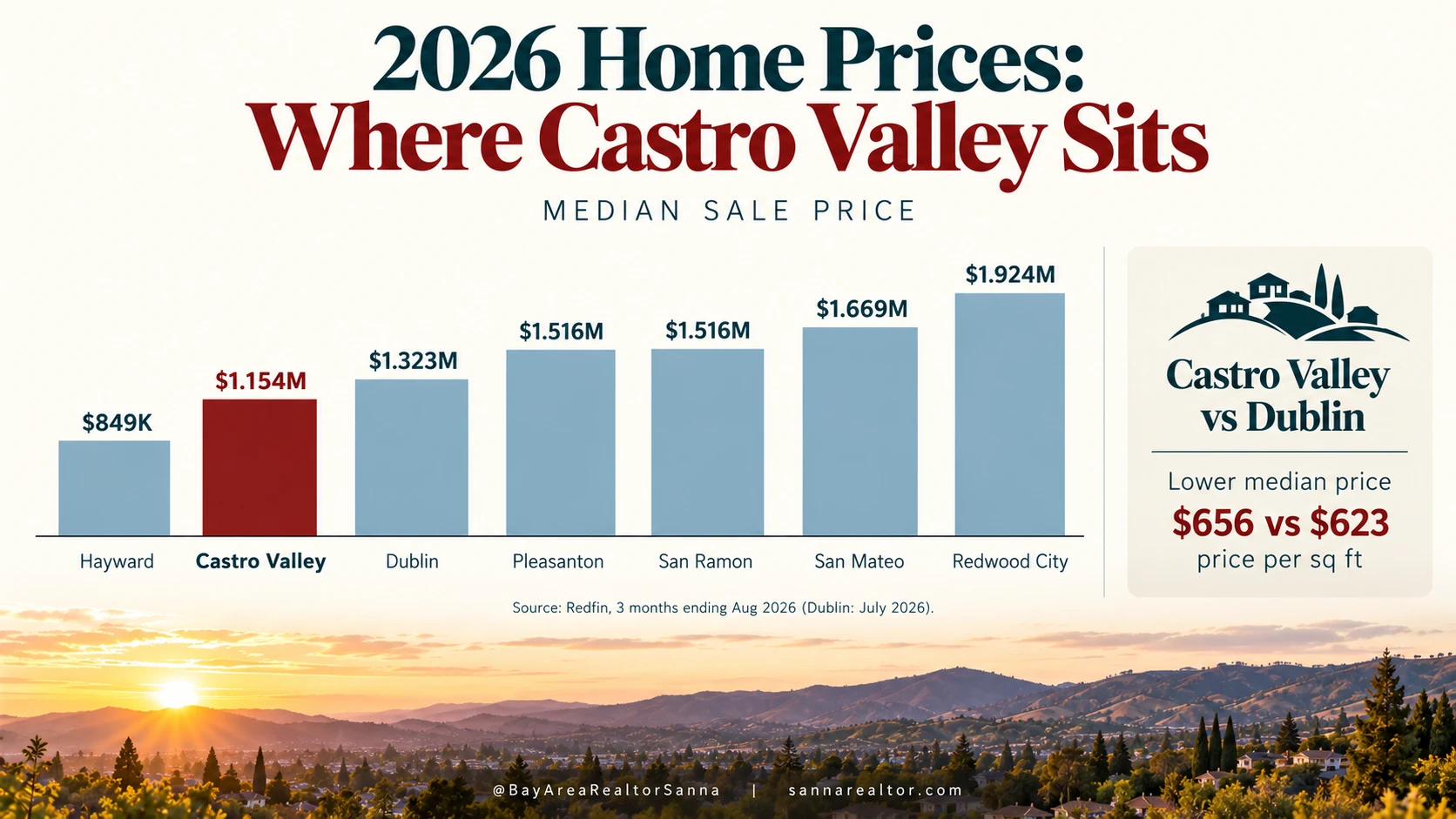
The median sale price in Castro Valley was $1,154,236 over the three months ending August 2026, up 2.3% from a year earlier, according to Redfin. The median price per square foot was $656, and homes typically sold in about 15 days. In August, the average home sold for 103.8% of list price and 55.4% sold above asking.
In other words, Castro Valley is not an undiscovered bargain. It is a competitive market.
Castro Valley vs. nearby Bay Area markets
| Market | Median sale price | Price per sq ft | Gap vs. Castro Valley |
|---|---|---|---|
| Castro Valley | $1,154,000 | $656 | — |
| Hayward | $849,000 | $558 | $305,000 lower |
| Dublin\* | $1,323,000 | $623 | $169,000 higher |
| Pleasanton | $1,516,000 | $791 | $362,000 higher |
| San Ramon | $1,516,000 | $694 | $362,000 higher |
| San Mateo | $1,669,000 | $1,060 | $515,000 higher |
| Redwood City | $1,924,000 | $1,150 | $770,000 higher |
Redfin, three months ending August 2026, all home types. \Dublin's latest Redfin figure is for the three months ending July 2026. These are market-wide medians, not prices for comparable homes.*
Is Castro Valley cheaper than Dublin?
Castro Valley's median price is about $169,000 lower than Dublin's, but its price per square foot is higher: $656 versus $623. So "Castro Valley is cheaper than Dublin" is only partly true. Castro Valley costs less to enter, but buyers are often comparing older, smaller Castro Valley homes with newer, larger Dublin homes.
What are buyers paying for compared with Hayward?
Hayward's median is about $305,000 below Castro Valley's. Buyers paying that premium are generally paying for Castro Valley Unified schools, location, BART access and limited housing supply. Before paying it for a specific house, confirm the house actually delivers those things, starting with the school district.
Thinking of selling in Castro Valley? With homes selling in about 15 days and more than half going over asking, pricing strategy matters more than ever. Book a 30-minute pricing consultation or call/text 415.548.3068.
Why is Castro Valley's location more useful than it looks?
Castro Valley is not midway between San Francisco and Silicon Valley; the Peninsula is. But Peninsula centrality is expensive: San Mateo's median is about $515,000 higher and Redwood City's about $770,000 higher. The real question for many households is how much extra commute they will accept for a much lower entry price.
Hybrid work changes that math. A 60-minute commute five days a week is a very different decision from the same trip twice a week.
Castro Valley commute summary
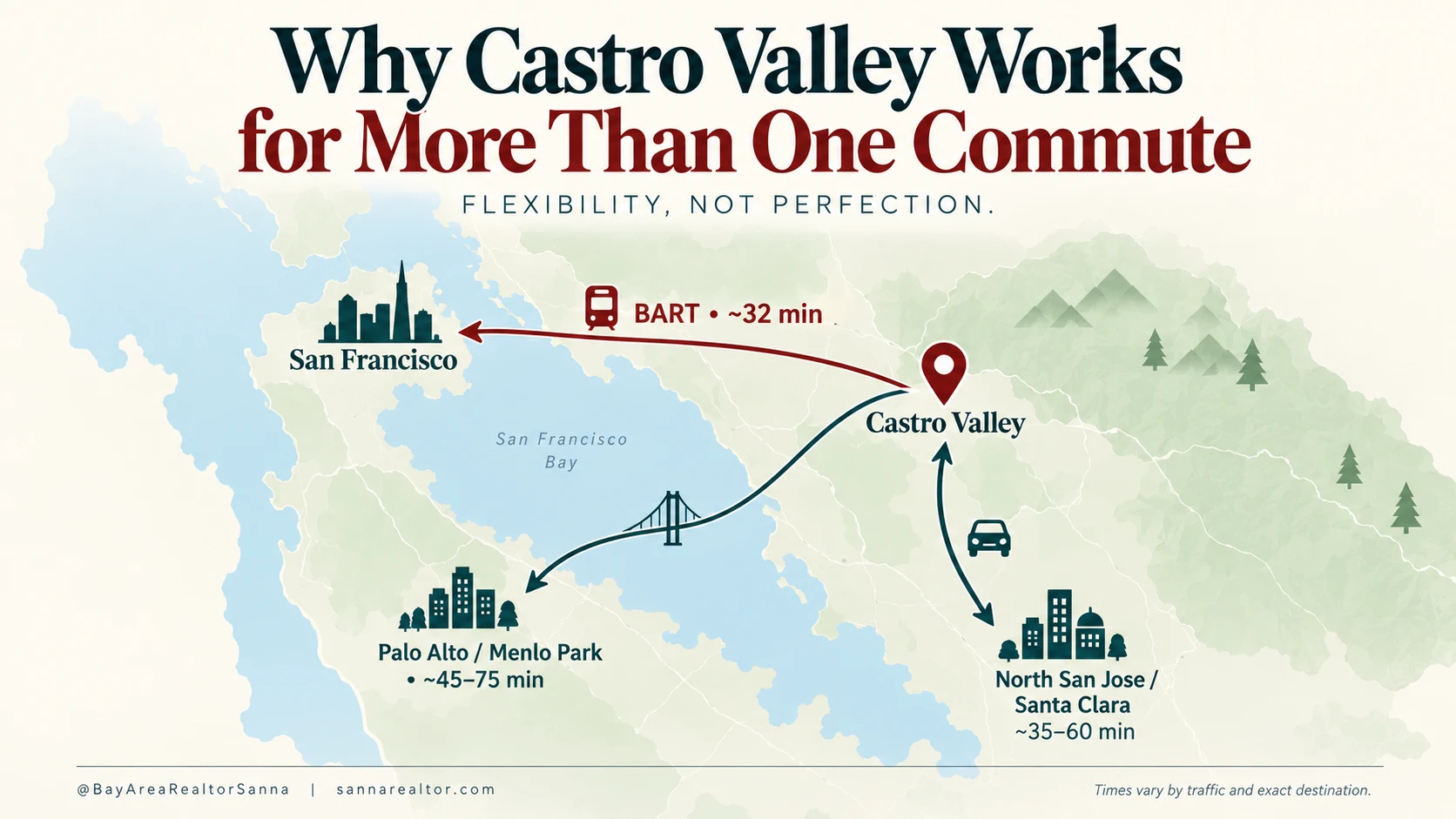
| Destination | Best mode | Typical time | Notes |
|---|---|---|---|
| Downtown San Francisco (Embarcadero) | BART, direct | \~32 min station to station | Blue Line, no transfer |
| Downtown Oakland | BART or I-580 | \~20–30 min drive; \~20 min BART to Lake Merritt | Direct BART to Lake Merritt; 12th/19th St need a transfer |
| Dublin/Pleasanton | BART or I-580 | \~10–20 min drive; \~10 min BART | Direct Blue Line east |
| Palo Alto / Menlo Park | Car | \~45–75 min at peak | I-880 plus Dumbarton or San Mateo Bridge |
| North San Jose / Santa Clara | Car | \~35–60 min at peak | I-880 or I-680; BART needs a transfer |
Times are approximate weekday-morning estimates and vary widely with traffic.
How long is the commute from Castro Valley to San Francisco?
The BART ride from Castro Valley to Embarcadero takes about 32 minutes, direct, with no transfer. Castro Valley has its own station on the Blue Line (Dublin/Pleasanton–Daly City). San Francisco is Castro Valley's strongest commute.
That 32 minutes is station to station. Door to door, add the trip to the station and from BART to your office. That is why BART's value varies so much by neighborhood: living near downtown Castro Valley is a very different experience from living deep in Five Canyons or Palomares Hills.
What is the commute from Castro Valley to Palo Alto and the Peninsula?
Castro Valley to Palo Alto is a driving commute of roughly 45 to 75 minutes at peak, usually via I-880 and the Dumbarton Bridge, with no practical direct transit option. Menlo Park, Redwood City and Mountain View are similar, and times vary a lot with bridge traffic.
I would not describe Castro Valley as "convenient to Palo Alto." I would describe Palo Alto as reachable from Castro Valley at a far lower housing price than most Peninsula options. For a five-day Palo Alto commuter, that can be a real negative. For a household where one person drives to Palo Alto twice a week and the other takes BART to San Francisco, it can work well.
What is the commute from Castro Valley to San Jose and Silicon Valley?
Castro Valley to North San Jose or Santa Clara is mainly a driving commute of roughly 35 to 60 minutes at peak, via I-880 or I-680. BART reaches Milpitas and Berryessa/North San José, but Castro Valley riders must transfer at Bay Fair, so it is not the simple one-seat ride they get to San Francisco.
The rule of thumb: San Francisco is a strong transit commute. The Peninsula and South Bay are driving commutes. Price that difference into the home.
What about Oakland, Berkeley and the Tri-Valley?
Castro Valley is close to Oakland by BART and I-580, and the same Blue Line runs east to Dublin and Pleasanton. That gives Castro Valley a wider job radius than many buyers expect. One person might work in San Francisco and the other in Pleasanton. Someone might work in Oakland now and move to a Tri-Valley employer later. The commute changes; the house doesn't have to.
Will BART service to Castro Valley be cut in 2027?
BART's service level from January 2027 depends on a regional transit funding measure on the November 3, 2026 ballot. BART's adopted FY27 budget assumes the measure passes and brings in about $74 million this fiscal year, against a structural deficit of about $375 million.
If the measure fails, BART's board-approved Alternative Service Plan would start in January 2027. It calls for roughly a 63% reduction in train hours and three-line service. The Blue Line, which serves Castro Valley, is one of the three lines kept, but the plan also includes station closures that the BART Board would decide later.
This is not a reason to assume Castro Valley loses BART. It is a reason for buyers paying a premium for BART proximity to follow the outcome. (This section will be updated after the November 3 election.)
Can you live in Castro Valley without a car?
You can live without a car in central Castro Valley near the BART station and Castro Valley Boulevard, but most of Castro Valley is car-dependent, with a Walk Score of 40. AC Transit Line 28 links Castro Valley BART with Castro Valley Boulevard, Redwood Road and Seven Hills Road, plus Bay Fair, San Leandro and Hayward BART. In the hills, plan on a car for most errands.
Regional access does not mean neighborhood walkability. A home can be well connected to the Bay Area and still require a car for groceries.
Comparing commutes for your specific office? I'll map door-to-door times from the neighborhoods you're considering to where you and your partner actually work. Book a 30-minute call or call/text 415.548.3068.
Castro Valley neighborhoods: which areas should buyers know?
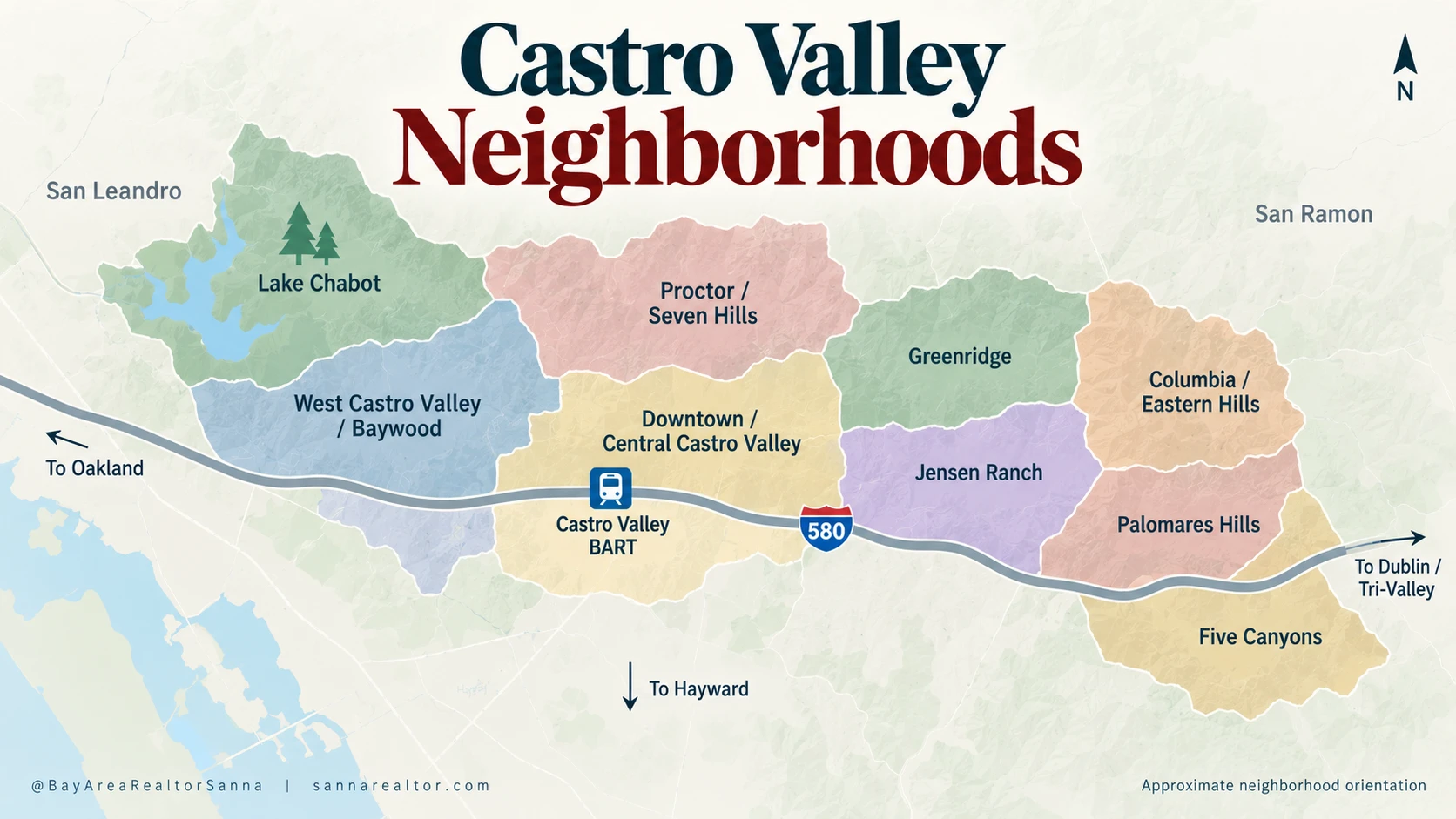
The main Castro Valley neighborhoods are Downtown/Central, West Castro Valley and Baywood, Lake Chabot, Proctor and Seven Hills, Greenridge, Columbia and the eastern hills, Jensen Ranch, Palomares Hills and Five Canyons. Boundaries are informal: residents, listing sites and the county don't always use the same names. I think of them as housing environments rather than neat boxes.
| Area | ZIP | Housing | Best for |
|---|---|---|---|
| Downtown / Central | 94546 | Older, varied homes | BART commuters, walkability |
| West CV / Baywood | 94546, 94578 | Postwar homes | I-580/I-238 access (verify school district) |
| Lake Chabot | 94546 | Wooded, hilly lots | Outdoor access |
| Proctor / Seven Hills | 94546 | Mid-century, ranch, split-level | Established neighborhoods |
| Greenridge | 94552 | \~185 Eichlers (1960–65) | Mid-century modern buyers |
| Jensen Ranch | 94552 | Suburban, later construction | Quieter residential feel |
| Palomares Hills | 94552 | Newer detached and attached, HOAs | Newer homes, views |
| Five Canyons | 94552 | Planned subdivisions, HOAs | Open-space access |
Downtown and Central Castro Valley
Downtown is the best area for buyers who want BART access. Homes near Castro Valley Boulevard are close to the station, restaurants and shops. Housing is older and more varied than in the planned communities. You trade seclusion and canyon views for transit and daily convenience, and for a regular San Francisco commuter, distance to BART can matter more than an extra bedroom.
West Castro Valley and Baywood
Western Castro Valley gives easier access toward San Leandro, Bay Fair and the I-580/I-238 interchange. This is also where school-district boundaries need the most care. A Castro Valley mailing address is not proof of Castro Valley Unified assignment.
Lake Chabot
The Lake Chabot area is defined by Lake Chabot Regional Park, which surrounds a 315-acre reservoir built in 1874–75 that still serves as a standby emergency water supply. The park offers fishing, boat rentals, a marina and more than 20 miles of trails connecting to Anthony Chabot Regional Park. Swimming isn't allowed. Nearby homes feel more wooded and hilly, so look harder at drainage, vegetation, slope and insurance.
Proctor and Seven Hills
Proctor and Seven Hills are established neighborhoods with many postwar, mid-century, ranch and split-level homes on hillier streets. Here I spend less time on staging and more on the bones of the house. A remodeled kitchen tells you nothing about the foundation, drainage, sewer line, roof or electrical system.
Greenridge
Greenridge has about 185 Eichler homes built between 1960 and 1965 from designs by Jones & Emmons and Claude Oakland. It is one of the largest Eichler neighborhoods in the East Bay and one of Eichler's few hillside developments, so some homes have views of the bay and city lights. Features include post-and-beam construction, floor-to-ceiling glass, atriums and radiant-floor heating.
Inspect an Eichler differently from a conventional ranch house. Slab condition, radiant heating, roofing, glazing and past renovations all need specialized attention.
Columbia and the eastern hills
Moving east, housing is increasingly shaped by hills, canyons and open space, with curving streets and permanent open-space areas in the planned developments. The buyer equation shifts away from walkability and toward views, space, road access and the physical site.
Jensen Ranch
Jensen Ranch feels more suburban and residential than downtown, generally with somewhat later construction and easier I-580 access than homes on the Lake Chabot side. There is no single Castro Valley commute: the distance from your house to BART and the freeway matters.
Palomares Hills
Palomares Hills is generally newer than central Castro Valley, with both detached homes and attached homes such as townhouses. HOAs play a bigger role here. Beyond the house itself, review HOA dues, reserves, common-area responsibilities, insurance and any sub-association.
Five Canyons
Five Canyons pairs planned subdivisions with Five Canyons Open Space: more than 300 acres and five miles of trails, including a segment of the Bay Area Ridge Trail connecting to Cull Canyon and Don Castro. Expect more car dependence and possible HOA obligations. Five Canyons is served by Castro Valley Unified; the area was transferred from Hayward Unified.
Are Castro Valley schools good?
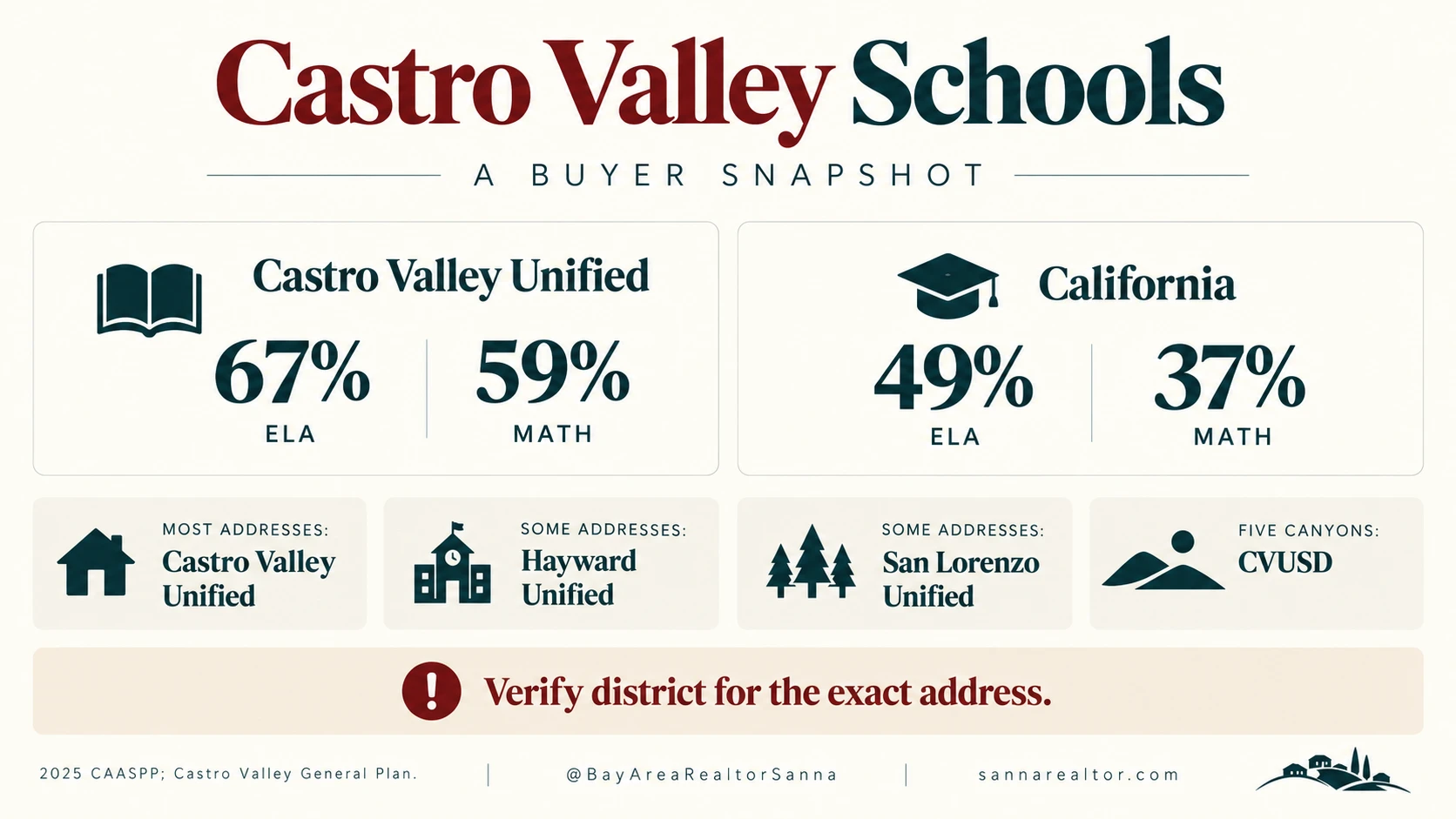
Castro Valley Unified scores well above state averages: in 2025, 67% of students met English standards (vs. 49% statewide) and 59% met math standards (vs. 37% statewide). But not every Castro Valley address is in Castro Valley Unified. Parts of the area are served by Hayward Unified and San Lorenzo Unified, so verify the district for the exact property.
For any home, I start with three questions:
- Which district serves this exact address?
- Which school is currently assigned?
- What do several years of official state data and the programs that matter to your family show?
The school shown on a listing portal should never be your final check. Confirm with the district before you write an offer.
Which schools are in Castro Valley Unified?
Castro Valley Unified has nine elementary schools, two middle schools and one comprehensive high school:
- Elementary: Castro Valley, Chabot, Independent, Jensen Ranch, Marshall, Palomares, Proctor, Stanton and Vannoy
- Middle: Canyon and Creekside
- High: Castro Valley High School, plus Redwood Continuation High (an alternative program) and the Castro Valley Virtual Academy
Elementary placement is based on the home address. Enrollment pressure can affect actual placement, so confirm with CVUSD.
Vannoy Elementary hosts the district's Spanish Dual Language Immersion program. It uses a 90/10 model, starting with 90% of instruction in Spanish in the early grades and moving to a 50/50 balance by upper elementary.
Test scores vary by campus and by year, and they don't capture every program or student experience. Use them as one input, not the whole decision.
Does a Castro Valley address guarantee Castro Valley Unified?
No. Castro Valley Unified serves most of Castro Valley, but some Castro Valley addresses are in Hayward Unified or San Lorenzo Unified. This dates to district reorganizations in the 1960s, and it still surprises buyers who moved for the schools. Five Canyons is a notable case: it was transferred from Hayward Unified to Castro Valley Unified.
Need to confirm a school boundary before you write an offer? I verify district and school assignment for every home my buyers consider. Book a 30-minute call or call/text 415.548.3068.
What are property taxes in Castro Valley?
Castro Valley property taxes start at the base rate set by Proposition 13, applied to your purchase price, plus voter-approved bonds and special assessments. The total therefore lands above that base rate and varies by tax-rate area. Castro Valley Unified voters have rejected its recent parcel tax and bond proposals.
Two recent school measures failed, which is worth knowing because both would have raised tax bills:
- Measure I (March 2020): a $96-per-year CVUSD parcel tax. It got 64.4% yes but needed two-thirds.
- Measure B (June 2026): a $212 million CVUSD facilities bond. It got about 47% yes but needed 55%.
Existing voter-approved school bonds still appear on tax bills. Newer planned areas may also carry HOA dues or special assessments, so check the disclosures.
How to estimate your bill: ask for the seller's most recent tax bill, look up the property's tax-rate area with the Alameda County Treasurer-Tax Collector, and apply that total rate to your purchase price. Don't rely on the seller's current bill amount; Prop 13 reassesses the home at your purchase price.
What is the weather like in Castro Valley?
Castro Valley has a mild Mediterranean climate that is warmer and sunnier in summer than San Francisco or the bayside cities. Late-summer highs average in the mid-to-upper 70s °F, with September often the warmest month. Winter lows average in the low 40s, and annual rainfall is roughly 20 to 26 inches, mostly from November through March. Snow essentially never falls.
Local conditions vary with elevation and canyon exposure. Hillside and canyon homes can feel noticeably different from the valley floor.
What is downtown Castro Valley like?
Downtown Castro Valley is centered on Castro Valley Boulevard and has become more pedestrian-friendly, with more restaurants and gathering places. But it is a suburban commercial street, not a classic walkable downtown like Palo Alto, Los Gatos or downtown Pleasanton. I would not buy here for the downtown. I would treat it as one part of a broader location decision.
What parks and outdoor access does Castro Valley have?
Outdoor access is one of Castro Valley's strongest lifestyle advantages:
- Lake Chabot Regional Park: a 315-acre lake with fishing, boat rentals and more than 20 miles of trails linking to Anthony Chabot Regional Park
- Five Canyons Open Space: more than 300 acres and five miles of trails, including a Bay Area Ridge Trail segment
- Cull Canyon and Don Castro regional recreation areas, both connected to the Five Canyons trail network
It is unusual to have this much open space in a community with direct BART service into San Francisco. The same hills and canyons, though, drive some of the area's biggest property risks.
Is Castro Valley hilly?
Yes. Much of Castro Valley sits on steep hills, creeks and canyons, and Alameda County's Castro Valley General Plan identifies erosion, landslides, flooding and emergency-vehicle access as concerns in those areas. Hillside homes can offer views and privacy, but the site becomes part of what you are buying.
On a hillside property, check where water flows, any retaining walls, how the house sits on the slope, driveway access, drainage, foundation condition, and whether past grading or additions were permitted.
Does Castro Valley have earthquake risk?
Yes. Like the rest of the Bay Area, Castro Valley has significant earthquake risk, and the Hayward Fault runs along the western part of the area. Depending on location, the hazards include strong shaking, landslides and liquefaction. Risk varies by parcel, so review the Natural Hazard Disclosure and the California Geological Survey hazard maps for the specific address rather than generalizing from the community name.
Is Castro Valley at risk of wildfire?
Wildfire risk in Castro Valley is real but uneven. First Street data shown on Redfin estimates that 90% of Castro Valley properties have some wildfire risk over the next 30 years, with an overall rating of moderate. Risk is highest where homes border regional parkland and open space, where vegetation, terrain and limited road access combine.
The view may be an asset, and the insurance cost may be a liability. Get insurance quotes early in your due diligence, before you remove contingencies.
What should buyers inspect in older Castro Valley homes?
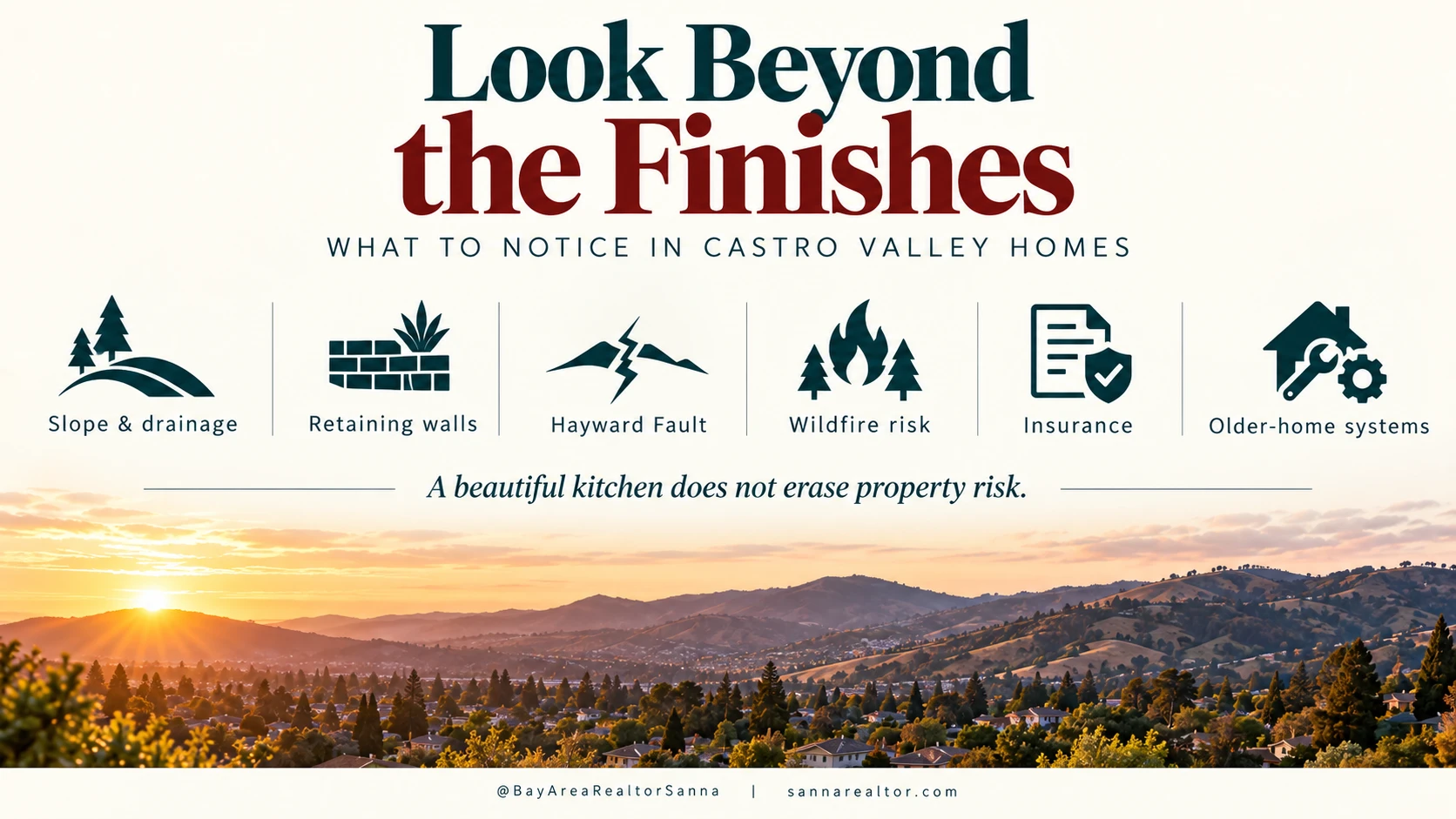
Much of Castro Valley's housing dates from the postwar and mid-century decades, so condition matters more than finishes. Focus on the expensive systems that are easy to overlook: electrical capacity, foundation, drainage, roof, HVAC, sewer line, windows, retaining walls where relevant, past additions and permit history.
Two homes with the same price and square footage can be completely different financial decisions. A beautiful kitchen remodel can make buyers forget they are buying a house that may be 60 or 70 years old.
Weighing a hillside or older home? I'll walk you through the disclosures, inspection findings and insurance picture before you commit. Book a 30-minute call or call/text 415.548.3068.
Is Castro Valley safe?
For crime data, go to the source rather than relying on opinions. Because Castro Valley is unincorporated, it is patrolled by the Alameda County Sheriff's Office, which publishes crime information and maps. Review recent data for the specific streets you're considering and compare it with other communities on your list.
Who is Castro Valley best suited for?
Castro Valley fits buyers who value flexibility over a perfect commute. It works especially well for households that want BART to San Francisco but also want room for future jobs in Oakland, the Peninsula, the South Bay or the Tri-Valley. Those commutes aren't all easy, but the location doesn't depend on one employer staying your employer forever.
When might Castro Valley be the wrong choice?
Castro Valley may be the wrong choice if any of these is your top priority:
- A five-day commute to Palo Alto or Cupertino. Paying more to live closer may be rational.
- New construction and highly planned neighborhoods. Parts of Dublin may fit better.
- A walkable, lively downtown. Castro Valley's commercial center is car-oriented.
- The lowest possible East Bay entry price. Compare Hayward first.
- Peninsula proximity. If it's worth the premium, San Mateo or Redwood City may be worth paying for.
The point isn't to prove Castro Valley wins. It's to identify which trade-off you prefer.
How do I evaluate a specific Castro Valley home?
I don't start with "Is Castro Valley a good place to buy?" I start with "Does this specific house solve the right problems for this buyer?" That means checking:
- The exact school district and current school assignment
- The commute at the hours you actually travel
- Distance to BART and the freeway
- Slope, drainage and the hazard disclosures (wildfire and seismic)
- Insurance quotes
- The age and condition of major systems
- HOA documents, where applicable
- Comparable sales
Then I run one more test: what happens if your job changes? If your office moves from San Francisco to Palo Alto, does the house still work? If your return-to-office policy goes from two days to four, does the commute become unacceptable? Those questions aren't on a listing sheet, but they can matter more than quartz countertops.
Frequently asked questions about living in Castro Valley
No. Castro Valley is an unincorporated community in Alameda County, so the county handles planning and services and the Alameda County Sheriff's Office provides policing. It had 66,441 residents in the 2020 Census.
The median sale price in Castro Valley was about $1,154,000 over the three months ending August 2026, according to Redfin, with a median of about $656 per square foot. Prices vary widely by neighborhood, home type and condition.
Yes. Castro Valley has its own BART station on the Blue Line (Dublin/Pleasanton–Daly City), with direct service to downtown San Francisco and east to Dublin and Pleasanton.
The direct BART ride from Castro Valley to Embarcadero takes about 32 minutes with no transfer. Door-to-door time depends on how far your home and office are from the stations.
Castro Valley's median price is lower than Dublin's: about $1.15 million versus about $1.32 million. But Castro Valley's price per square foot is higher, $656 versus $623, largely because its homes tend to be older and smaller.
No. Most of Castro Valley is in Castro Valley Unified, but some addresses are in Hayward Unified or San Lorenzo Unified. Always verify the district and school assignment for the exact property with the district.
Castro Valley's main ZIP codes are 94546 (central and western Castro Valley, including downtown and the Lake Chabot side) and 94552 (the eastern hills, including Five Canyons and Palomares Hills). A few western-edge homes use 94578.
Commonly used areas include Downtown/Central, West Castro Valley and Baywood, Lake Chabot, Proctor, Seven Hills, Greenridge, Columbia, Jensen Ranch, Palomares Hills and Five Canyons. Boundaries are informal, so focus on the actual property's location and characteristics.
Castro Valley works well for tech workers who value access to several job centers. San Francisco has a direct BART option, while Peninsula and South Bay offices generally require driving. It suits hybrid workers better than five-day Peninsula commuters.
Mostly no. Castro Valley has a Walk Score of 40, which means car-dependent. Central areas near Castro Valley Boulevard and BART are the most walkable; hillside and outer neighborhoods generally require a car.
Castro Valley is warmer and sunnier in summer than San Francisco. Late-summer highs average in the mid-to-upper 70s °F, winter lows in the low 40s, and annual rainfall is roughly 20 to 26 inches, mostly from November through March.
Wildfire risk varies by location. First Street data on Redfin rates Castro Valley's overall risk as moderate, with 90% of properties facing some risk over 30 years. Homes next to regional parks and open space carry the most risk.
The Hayward Fault runs along the western part of the Castro Valley area. Earthquake hazards there include strong shaking, landslides and liquefaction depending on location, so check the hazard disclosures for each specific property.
What is the real Castro Valley advantage?
Castro Valley doesn't win every Bay Area housing category. Its appeal is the combination: BART to San Francisco, driving access to the Peninsula and South Bay, the Blue Line east to Dublin and Pleasanton, large regional parks, and a median price far below much of the central Peninsula.
But buyers need to know exactly what they're buying. The school district matters. The hillside matters. The age of the house matters. The fire and earthquake maps matter. BART access matters. And your future commute may matter almost as much as your current one.
You may own your home for ten years, and you probably won't have the same employer, office or work-from-home policy for all ten. So instead of asking only "Does this home work for my life today?", ask: "How many versions of my future life could still work from here?" For the right buyer, that may be Castro Valley's most valuable feature.
This guide explains how the rules work as of October 2026, with sources named. It is not legal, tax, lending, insurance, engineering or investment advice. Rules change and individual situations differ — confirm how these apply to you with the relevant agency or a qualified professional before acting.
Sanna Syngal · DRE# 02191250 · RE/MAX Accord
Sources
- Redfin: Castro Valley housing market (also the source of Walk Score and First Street hazard data)
- Redfin housing market pages: Hayward, Dublin, Pleasanton, San Ramon, San Mateo, Redwood City
- U.S. Census Bureau QuickFacts: Castro Valley CDP
- BART: FY27 budget adoption and BART funding overview fact sheet (July 2026)
- AC Transit Line 28
- Castro Valley Unified: academic results and Dual Language Immersion program
- Patch: Questions answered on CVUSD boundaries
- Ed-Data: Redwood Continuation High
- East Bay Regional Park District: Lake Chabot and Five Canyons Open Space
- Eichler Network: Greenridge
- Castro Valley General Plan (Alameda County)
- CVHS Olympian: Measure I results (2020) and Piedmont Exedra: June 2026 Alameda County school measures
Sanna Syngal — Realtor, RE/MAX Accord — California DRE #02191250
This guide is general information and reflects conditions checked through October 2026. Prices, school assignments, tax rates, insurance conditions and transit service change. Confirm current comparable sales, school assignment, tax-rate area, hazards, insurance and legal requirements with the appropriate agencies and qualified professionals before making a decision. Equal Housing Opportunity.